Wednesday, July 26, 2006

Burma Journal: On The Road to Mandalay


Burma Journal; The Road To Mandalay

© 2006
by Richard W. Wise

Day one:

I take the night plane from Bangkok and arrive in Yangon on Tuesday, March 1st. My old friend Lwin (pronounced Lu-win) my guide during my last trip met me at the airport. Lwin is a dark haired, middle aged fellow dressed in the traditional Burmese Longji, a tight wrap around skirt. An ethnic Shan, Lwin grew up in Mogok, a member of the tribe that has controlled the gem mining districts for centuries.

I Checked into an old hotel in the old part of downtown Rangoon. (I am having trouble using the new terminology, Burma will always be Burma and I prefer Rangoon to the newly minted “Yangon.”) The hotel is an old one with its dusty corridors, polished teak floors, squeaking ceiling fan and wide shutters it thrusts me back into my daydreams of old Burma.

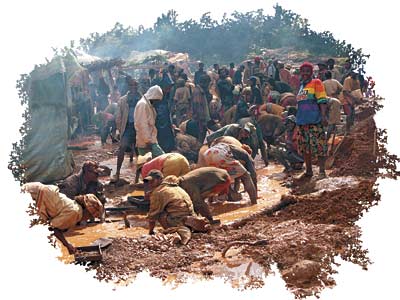
My plan for a second visit to the ruby mining town of Mogok in the famous Valley of the Serpents has been derailed. The valley has, once again, been closed to westerners. The army has screwed the lid down tight. Lwin’s old friend the general, from whom we got a pass last time, has been put in jail. Oh well, I only traveled twenty-five thousand miles to get here. Lwin has an alternate plan. He suggests that we travel to Mandalay by car. Mandalay is only about six hours from Mogok. Lwin will contact the miners who will meet us in Mandalay. Meanwhile I’ll get to tour the country.

We will take it easy and do the trip in three stages... The first day we will drive two hundred miles upcountry and stop in a small town at a hotel that Lwin knows well. The second stage, another five or six hours by car, will bring us to the ancient temple city of Pagan (Bagan). We will visit and photograph a few of the major pagodas, stay overnight, and travel the short leg to Mandalay the next morning. The more I chew over this suggestion the better I like it. It’s a chance to see the countryside. After a hectic week in Bangkok I can use a break.

The next morning promptly at nine, (Lwin) and his friend John, (a thin dark skinned missionary educated Burmese of about fifty with an excellent command of English) show up and we plan our itinerary. The only thing I don’t like is the return, four hundred miles from Mandalay to Rangoon. in one shot. Lwin proposes an alternative. One way by air!, that sounds better; ok, deal!
We spend the morning visiting Rangoon dealers who have ruby and sapphire to sell. Prices, as my Bangkok contacts predicted, are very high, as high or higher than in Bangkok. Only see one stone I like, a 1.74 carat cushion shaped Burma ruby from the new mine at Namya. The color is not quite right so I pass without making an offer. I bought three exceptional heated rubies from the Mong Hsu mine in Bangkok. One oval started off at 1.88 carats. The stone showed exceptional “pigeon blood” color but required a slight shaving of the pavilion, a small sacrifice of weight to sharpen the crystal and bring out the saturation it finished at 1.74 carats. Mong Hsu stones are often a purer red hue than old mine stones; the usual secondary hue is purple. Mogok rubies tend toward the pink. Another, a 1.36 carat round (pictured) was a real find. I found another, a 3.60 carat oval paradigm, one of the finest rubies I have ever seen. Perfection is expensive but I had to buy it.
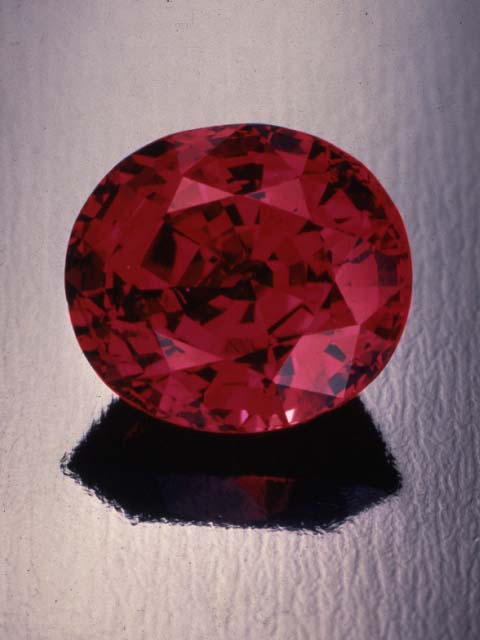


Natural color or burned (heat treated), rubies of fine color are extremely scarce, almost as rare as untreated. I must have closely examined over a hundred burned stones. In the ruby trading capital of the world, I saw almost nothing of fine color. One more stop and we see a few more rubies and a large sapphire. The sapphire color is good the lovely purplish blue “peacock” hue that Burma is famous for but unfortunately the stone is overcolor, too dark in tone.

I return to the hotel for checkout. First stop a small local restaurant that Lwin favors. The restaurant located on a side street It has an front wall open to the street. It’s a little lacking in ambience, with plain well-scared wooden tables, serviceable chairs and no tourists, a restaurant in a garage. We amble up to the front counter that is set up sort of delicatessen style. With Lwin’s guidance I pick out my dishes. The place is bustling, people dressed in the traditional Longji with a western shirt or top, eating talking and generally having a good time.

Burmese cooking features a broad palette of herbs and spices. We try mint leaves, chili, lemon, and a saffron flavored curry all served over rice. Burmese food pleasantly hot but Lwin cautions, beware of the cute little green chilies, they can change your life.

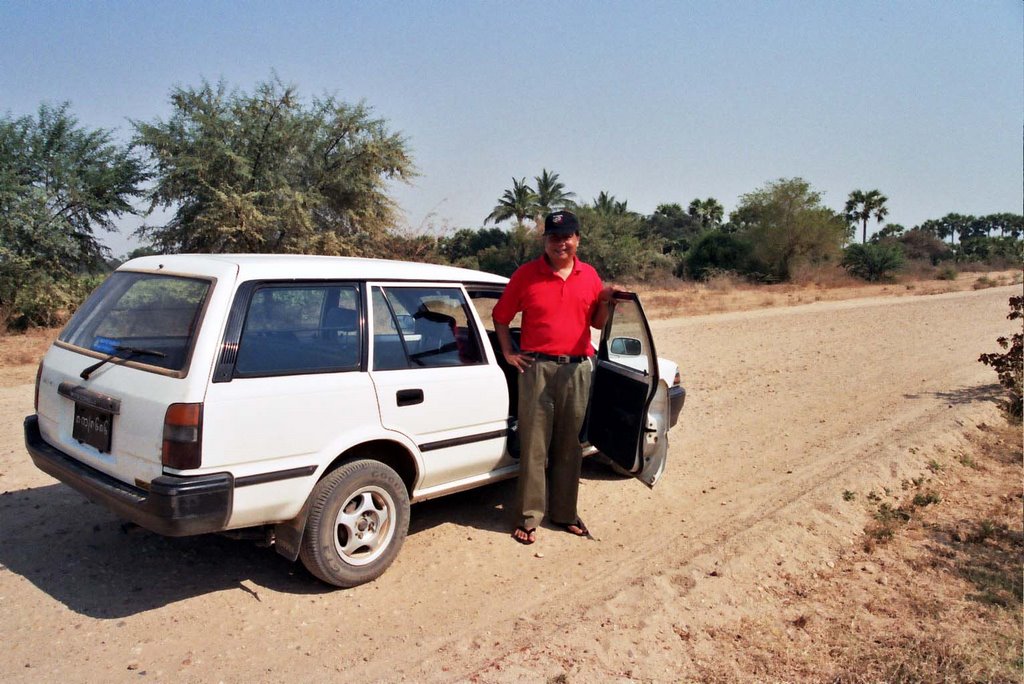
Fuel, gasoline and diesel is rationed in Burma. You are allowed two gallons per day. Lwin has a coupon book. Although his 1990 Toyota Corolla is diesel, this trip will require a good deal more than two gallons of fuel Per day. The two gallons are very cheap, 160 kyat. (900 kyat = $1.00 on the black market, the official rate is 500). For additional fuel you must pay the black-market price, about two fifty US per gallon at the unofficial exchange rate. Luckily you do not have to go down a dark alley or know the secret handshake; you just pay the additional money and receive your fuel at the same government controlled gas station where you purchased your legal ration.

Well, its 2;00 PM., fed and fueled, off we go on the first leg of our trip along the road to Mandalay. Once we clear Rangoon‘s noisy environs, we find ourselves on a blacktopped one and a half lane country road with traffic moving in both directions. The day is hot and the road dusty. The ride through the countryside is not disappointing. This road, clearly a main artery, provides a running panorama of life in rural Burma. Did I say rural Burma? All of Burma outside the few cities is rural. Burma is a nation of farmers.

Driving the road requires a bit of etiquette. Compact cars going in opposite directions can pass each other, barely. But if you meet a lorry there is a delicate two-step that usually finds the smaller vehicle giving the most ground. Luckily outside the city, most of the traffic is made up of bicycles, trishaws and bullock carts.

The trishaw is a unique and interesting vehicle. It is basically a bicycle with a one-wheeled sidecar. It is the Burmese peasant’s answer to the family automobile. With a little planning it’ can carry five. Two in the sidecar, (wife facing front, mother-in-law facing rear); one child on the rear fender and another on the front handlebars. If you are a farmer, the bullock cart may be your vehicle of choice. Two yoked bullocks power this handmade wooden beauty. A bit slow off the line, it sports a five-foot wheelbase and can easily carry a large family and the family groceries. It’s a multi-purpose vehicle, sort of a third world SUV. When not in use carrying passengers it is perfect for off-road use (harvesting crops). It is easily navigable through all but the deepest rice paddies.

Lwin is the type of driver whose driving style would reduce a New York cabbie to fear and trembling. His technique is simple: If its smaller just keep punching the horn until it moves to the side of the road. If the vehicle is bigger than you are; keep on keeping on until the very last minute. The other guy will probably give a little and if that’s not enough its up and over the shoulder. Watch that bullock cart! He has a manual shift, four on the floor, but mostly uses two just two…fast and stop. At the end of the journey I can recall only one instance when we were passed (a large bus on a dirt road). The rest of the time it was us passing them. The man is the Burmese version of a grand prix racer. I am sure we passed half the motorized vehicles in Burma.
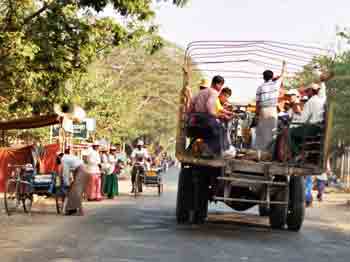
Along many sections of the road huge ancient Acacia trees, dating from the days of the British Raj, form a canopy shading the road.. Rice appears to be the dominant crop and we pass field after field with rows upon row of tender green shoots.

Six hours later we pull up at a bungalow hotel in the small town of Brome about two hundred miles south of Bagan. The hote
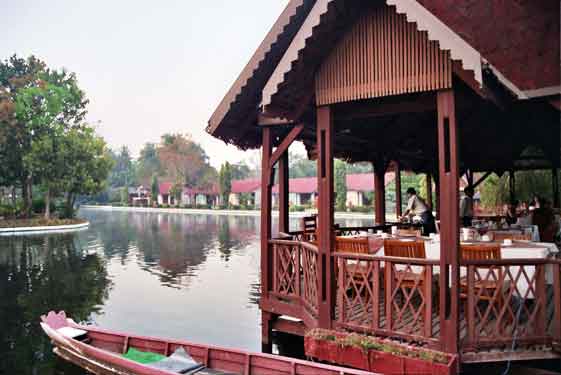
l is situated on a small lake and we eat our dinner al fresco on a covered deck overlooking the water. The food is good; I have a chicken stir fry dish laced with cashews. The night is hot and sultry, the food delicately flavored. Burmese music blasts from a loudspeaker somewhere in the distance.
Like the blog? You will love the book!


"This book takes a much-needed sledgehammer to the industry's conventional wisdom about what makes a gemstone precious, and in the process builds a solid foundation for anyone who wants to understand the true beauty and value of gemstones."

Morgan Beard
Editor-in-Chief Colored Stone Magazine

Read a free chapter www.secretsofthegemtrade.com


Sunday, July 16, 2006

Summer Shows at R. W. Wise, Goldsmiths


Michael Dyber, Gem Sculptor Extraordinaire

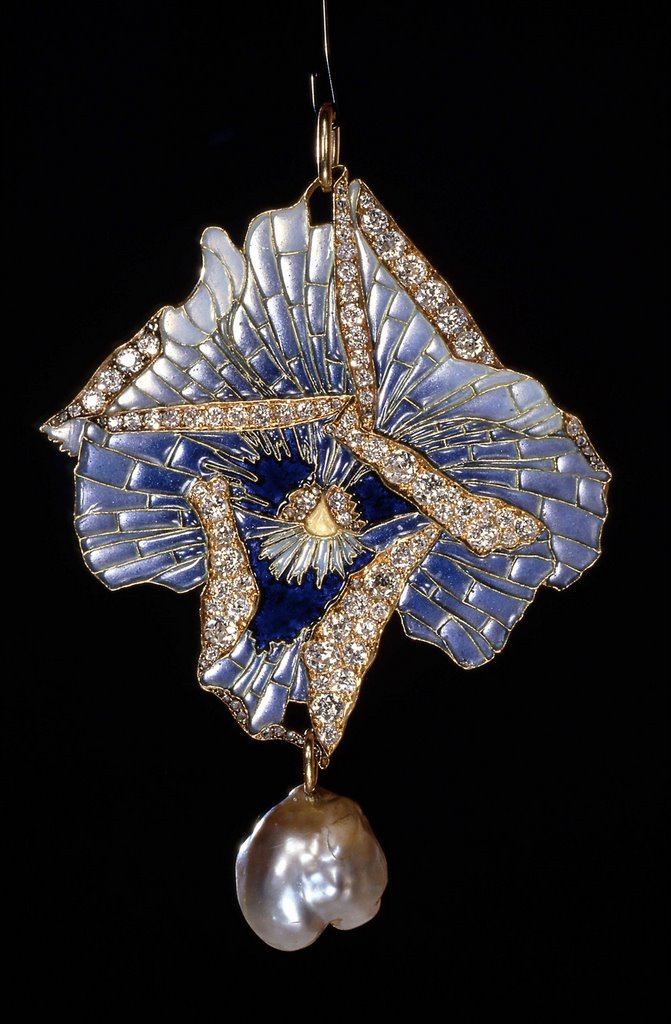
When I think about innovative gem cutting today, a few names spring to mind. One of the first is Michael Dyber. Like René Lalique (1860-1945) who initiated a revolution in French jewelry design (image left) by asserting that his work should be valued for its design and craftsmanship, rather than for the value of the materials used, Dyber creates subtle miracles in materials such as the humble quartz, amethyst and tourmaline.

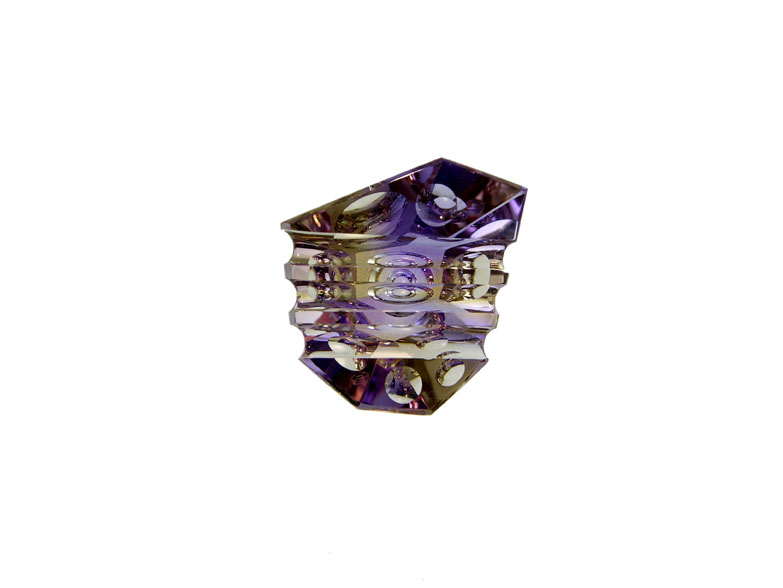
Michael Dyber’s total optical approach to lapidary breaks with the tradition of gem cutting that began in the Renaissance. His little masterpieces cross the line between the gem craftsman’s narrow pursuit of brilliance and scintillation and the constructivist artist’s desire to create a work of art with reflects a world with no physical reference. His work, together with artists like Steven Walters and Glenn Lehrer will, I believe,be one of the defining voices in jewelry making in the 20th Century. Pictured above is an one of a kind 89 carat aquamarine sculpture by Michael Dyber.

Dyber’s work is all about color, shape and balance. It is self-contained yet when set by the hand of a skilled and sensitve goldsmith who can preserve and amplify these qualites the colaboraton can produce a wearable masterpiece. Whether executed in quartz, tourmaline or Aquamarine, a Dyber centered piece projects beauty and sensitivity without ostentation.

Interpreting a Work of Art:

The image pictured (below right) is an excellent example of the silent colaboration that goes on between an artist/goldsmith and a Dyber gem sculpture. The center stone is a citrine sculpture. The necklace designed and handmade in our workshop by Douglas Canivet in a sand finished 18k yellow gold. The designer has taken the planes and angles of the sculpture as his point of departure. The bezel set diamonds act as both an accent and a counterpoint to the center stone. Our current display includes 20 Dyber sculptures in Rutilated Quartz, Sunstone, Tourmaline, Aquamarine and Chrysoprase. We have prepared several sketches of possible interpretations, ring, pendant or necklace.

It is difficult to believe that each of Michael's unique creation is only made once. The gallery located at 81 Church Street, Lenox, Massachusetts and is open daily; Monday-Saturday 10-5, Sundays 11-4. For more information or an informative brochure, kindly give us a call at 800.773.0249 (413.637.1589 in Berkshire County) or visit our website: www.rwwise.com

An informative article by Richard W. Wise on the gem sculpture movement can be found at Modern Silver Magazine: http://www.modernsilver.com/secretsofthegemtrade.htm

"Every goldsmith, jeweller, gemologist, gem lab, gem dealer and gemstone collector should have a copy of this book, especially gem collectors and connoisseurs, to whom the book is primarily aimed."

Charles Lewton-Brain
Canadian Jeweler, June/July 2004

Now in paperback: www.secretsofthegemtrade.com

You can now email this post (see ikon next to comments) or subscribe by email, by scrolling to the bottom of the page and adding youre email address. I absolutely will not pass on your email to anyone.

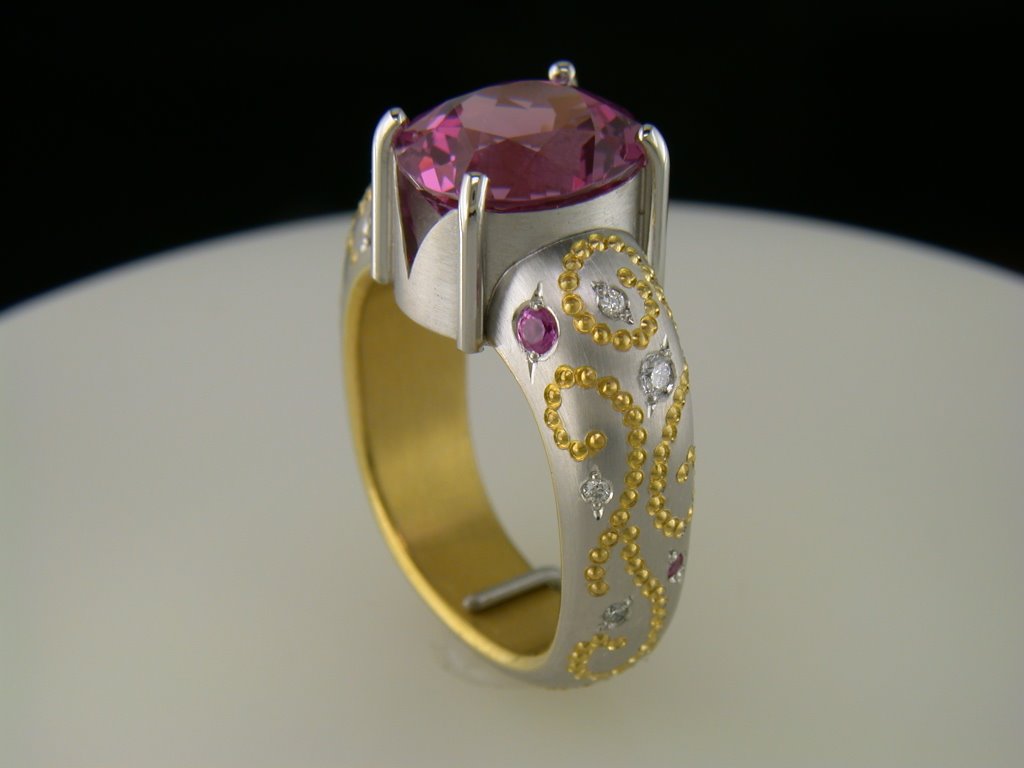
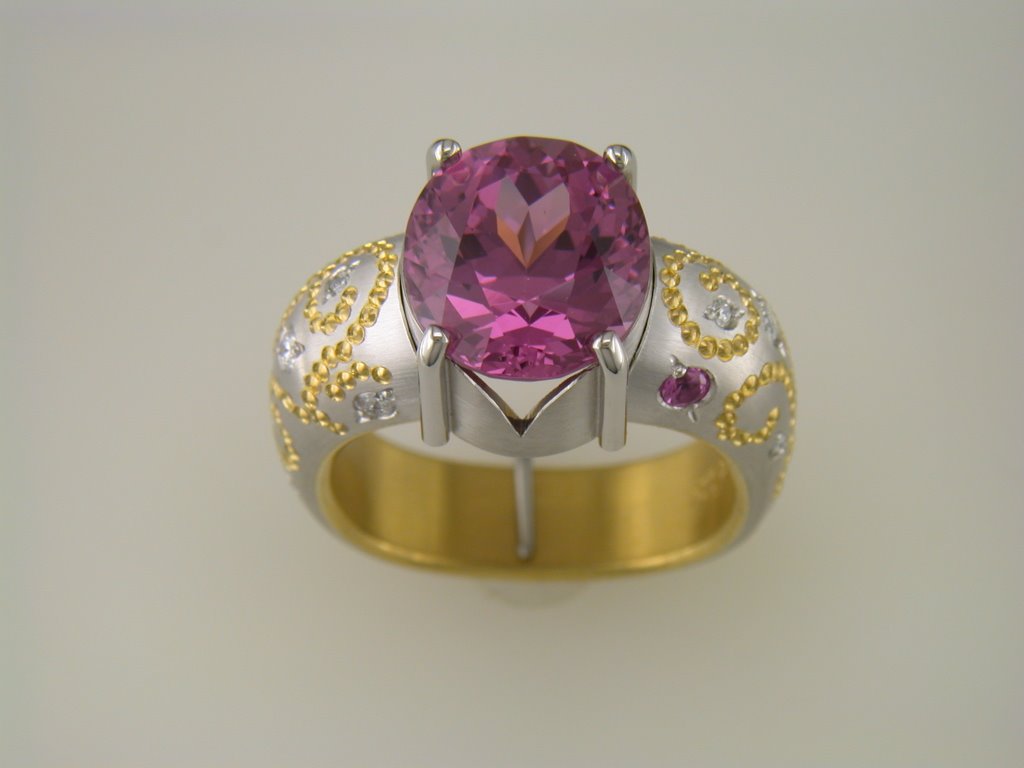
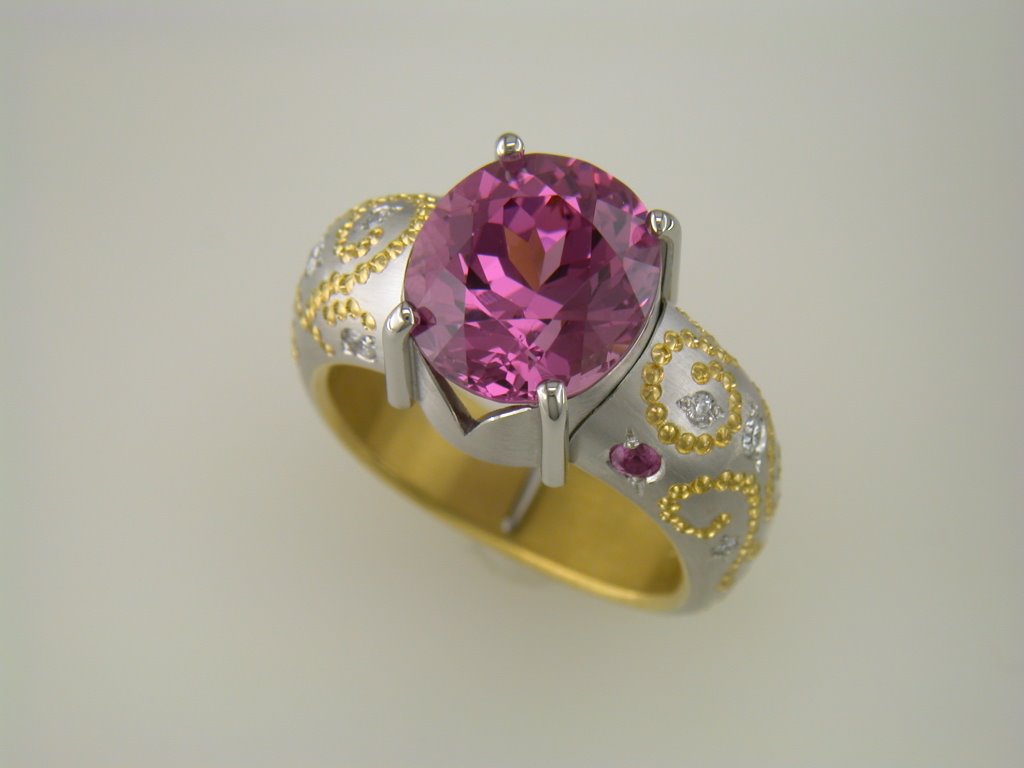
A New Ring from Zoltan David

An oval pink purplish spinel weighing 5.41 carats set with D-IF diamonds and pink sapphires. The ring is platinum with 22k inlays and a 22k inner sleeve.


Saturday, July 15, 2006

Gem Mining in Magagascar a three part series


BY VINCENT PARDIEU WITH RICHARD W. WISE

©2006

Moramanga mining village, Andilamena region, Madagascar, June 29, 2005

It is 4 a.m., and I can’t sleep. It’s been two hours since the local nightclub has ceased churning out the pop music that can turn this jungle city into a disco. The neighboring movie theater closed a few hours ago, and the choreographed grunts of the latest Kung Fu movie have faded into the darkness.

Still, the jungle night in this mining village is far from quiet. In fact, it sounds like a battlefield. By day, this shantytown of 15,000 is the kingdom of men, but the night is ruled by rats — thousands of them, perhaps millions. In each wooden shack, dozens of rats run over the sleeping bodies of men, women, and children. I don’t like rats, so I’ve made a small fire and installed some candles; that way I can at least work and think . . .

So begins Colored Stone Magazine's three part series on the gem mines of Madagascar. Follow the adventures of Vincent Pardeau as he treks through the the Madagascar outback to the wild west town of Moramanga. CS Magazine has very generously made our series available online. If you are not a subscriber, get with it. READ ON: http://www.colored-stone.com/stories/jul06/madagascar1.cfm


Richard W. Wise is a goldsmith and gemologist. He specializes in connoisseurship and has visited most of the world's major mining localities. His critically acclaimed book, now out in paperback can be reviewed at www.secretsofthegemtrade.com

Thursday, July 06, 2006

Summer Shows at R. W. Wise, Goldsmiths


"What do you do in the Berkshires all winter?"

Its a question people often ask! While the beavers are in hibernation, the creative sap is running free at R. W. Wise. We travel, we design, we create! This year we are honored to add two new artists to our list and to welcome back a third: Zoltan David and Michael Zobel. No strangers to the jewelry aficionado, these two artists come to us with multiple honors and international reputations. Michael Dyber is arguably one of the world's top gemstone sculptors. We have been loving and designing jewelry around his exciting pieces for years. This summer we have about two dozen of his sculptures on display.

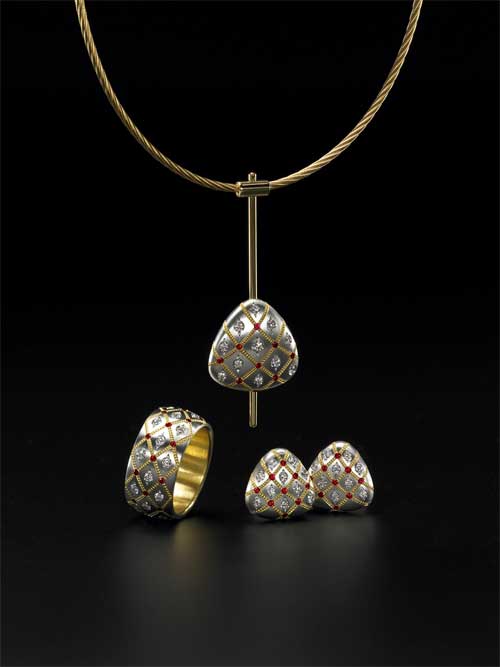
Image: Pictured (above) is a suite of handmade platinum/22k jewelry diamond and ruby jewelry on display in our gallery by the award winning American master Zoltan David.

Zoltan David won his very first international award in 1979 and he has never looked back. Originally from Budapest, Zoltan's father was a World War II hero and a freedom fighter in the Hungarian uprising in 1956. Forced to flee at the age of 6, Zoltan has never lost that passion which is his birthright. I have been following his career for many years and when we finally met this past Febuary, I knew he was a man with the sensativity needed to set some of our finest gemstones.

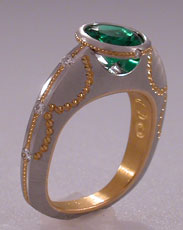
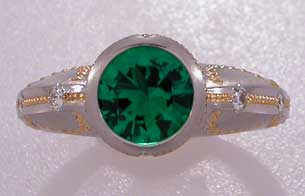
Image: Pictured right Zoltan David sets the first of our gems; a 1.31 carat flawless round Brazilian emerald. Note how the belly band protects the gem but allows free visual access to both the top and pavillion of the gem. (sold)

Tuesday, July 04, 2006

Cuprian Tourmaline from Mozambique; Super-star-stone or just Over-ripe-hype?


By Richard W. Wise, G.G.

©2006


A recent fi
nd of cuprian(copper colored) tourmaline from Mozambique is making a lot of waves among gemstone dealers and collectors..

Reportedly these gems come from an alluvial deposit near Mozambique's Alto Ligonha. Region. One source tells me that the water born material is essentially mined out a statement that should always be viewed skeptically. The source of these river pebbles is yet to be found. This same source suggests that the entire production may be less than 50 kilograms of rough stones.

Is Mozambique the new Paraiba?

Much of the material cuts eye clean gems. Unlike the original material from the now famous São José da Batalha mine in the Brazilian state of Paraiba and two similar Brazilian locations which yielded mostly visually included smaller gems, the Mozambique cuprian is larger and a number of eye-clean 20-60 carat stones have been cut.

The color is said to be a more uniformly "aquamarine blue" than gems from the Brazilian find which featured a color range of green, blue-ish-green to blue. The blue color, usually described as
Caribbean or Windex blue is dominant and the hue is described as "watery" meaning that the gems lack the supercharged saturation of the finest Paraiba stones. This is particularly true in cut gems in smaller sizes (under 5 carats). Larger size gems seem to hold the color better and appear to have saturation closer to their Brazilian counterparts. I have not seen enough of the stones to make a definitive statement but what I have seen is quite beautiful though paler in saturation than the best of Brazil. One dealer suggested to me that the blue-green material was far more beautiful.

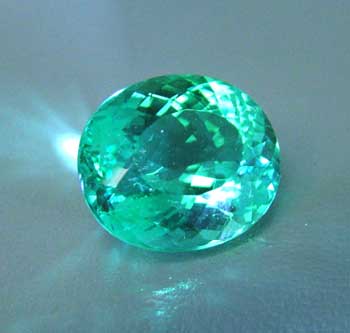
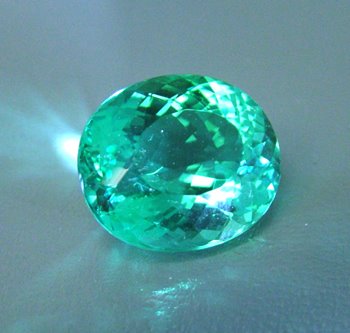
Image: Looking pretty super, this 13.42 carat oval is a highly saturated light-medium tone green-blue hue from
Mozambique

Prices:

Partisans of the new material from
Mozambique are touting it as "Paraiba tourmaline" and asking very aggressive prices. Several sources stated that dealers who are members of the American Gem Trade Association (AGTA) and have purchased significant amounts of rough material pressured the Gem Lab Standards Committee (GILC) for changes in terminology that would annoint these stones "Paraiba" on certificates issued by the AGTA Gem Lab. (see Pricing the crème, Part III). To be fair, CIBJO, the international committee that establishes terminology standards (bet you didn't know there was such a thing) in its 2005 Blue Book has recognized "Paraiba Tourmaline" as an acceptable trade name for cuprian tourmaline regardless of the source.

To Buy or not to buy, that is the dilemma:

The beginning is usually the best time to buy. Why?, because even a small strike can produce an initial flood of gemstones that overwhelms the market causing prices to fall. In a market of limited size such as the colored gem market, the discovery of a new gem variety or a known gem from a new source sparks interest and as interest grows demand increases. At the same time supply declines resulting in increasingly higher prices. We have seen this cycle repeat itself time and time again: Paraiba tourmaline, Spessartite Garnet, Demantoid Garnet are just a few examples of new gem strikes that are going through this sort of market cycle.

However, in the case, Mozambique cuprian tourmaline is being hyped as the "new Paraiba" and asking prices have started out very high despite the fact that the much of the new material does not measure up to the hype. As one source put it, on a scale of 1-10 where the best of the Paraiba Tourmaline would be a 8-10, the
Mozambique tourmalines are between 3-6.

With the rise of the shopping channels, gem marketing has entered a new era. During the past decade we have seen a consolidation in an industry previously dominated by wildcatters, small dealers with a limited stake and an even more limited budget. The shopping channels have become economic jugernauts. Selling directly to consumers, with millions in sales and huge numbers of viewers they have begun to control the market. Jewelry Television (ACN) which advertises itself as the world's largest retailer of loose gemstones, grossed over 300 million dollars last year. Witness the recent hype over Andesine (red sunstone) which the shopping channels are also calling “the new Paraiba”. In addition, we see a few big time dealers who watched the Paraiba phenomenon are holding large inventories of Mozambique rough and are determined to pump up the market and cash in big. Today, both these factors are at work and this has resulted in a distorted and overheated market.

My Advice:

If you are going to buy, buy high quality and buy big sizes. Larger stones are reported to "approach" the quality of the original find and if it looks like a duck… Stones from the original Paraiba mines are extremely rare over 5 carats and barely exist over 10. Otherwise, wait for the hype to die down! Market realities will eventually assert themselves and force prices into line with the relative quality of the gem on offer.

P.S. Cuprian vs. cuprite, whats in a name: My readers may have noticed a change in terminology from cuprite to cuprian this is the result of a gentle reminder from one of my faithful readers John S. White former Curator of the Smithsonian Mineral Collection: "Please, enough with this "cuprite tourmaline." Why do you continue to perpetuate what is unarguably the worst name that anyone has applied to Paraiba-like tourmaline? Cuprite is a distinct mineral species, it does not occur within or around gem tourmaline anywhere in the world. Furthermore, making the appellation even more ludicrous, cuprite is red, it is not blue nor green. You would be doing the gem world a favor if you would disavow your usage of this term while perhaps citing several of the others that have a far greater chance of being adopted." Thanks John!