GemWise

Gonzo journalism for gem & jewelry lovers!

Wednesday, August 23, 2006

Rating the Gem/Jewelry Forums

Rating the Gem/Jewelry Forums

by Richard W. Wise, G.G.

©2006

One pill makes you larger
And one pill makes you small
And the ones that mother gives you
Don't do anything at all
Go ask Alice
When she's ten feet tall”

The Jefferson Airplane

The Internet is a fund of information. And, as some say, the Internet is free; grass roots democracy, freedom of speech in action. You can say anything about anything. The fact is, this so-called freedom is somewhat illusory. Freedom of speech implies the freedom to be heard. Without that what have you got or as the British philosopher Berkeley once asked: If a tree falls in the forest and there is no one to hear it fall, does it make any noise”?

The freedom to be heard, aye that is the issue! Recently the search engine, Google, kowtowed to the China’s Communist government, agreeing to restrict content available through Google’s Chinese search engine. What do you suppose a Chinese citizen will get when he googles “free speech?” What a perfect segue into a discussion of online gem forums:

Gem/Jewelry Forums have been sprung up all over the net like brown fungi after a summer rain. The major forums are; Pricescope, Diamondtalk, Gemologyonline and Pearl-Guide. Each of these sites claim to be online communities advocating the rights of the consumer and promoting a free exchange of ideas and information. Some are part of for profit websites and some are non-profit. Are they really all they claim to be? What’s a consumer to believe? The quick answer, like fungi some are edible and others will upset your tummy, lets try and separate the mushrooms from their less palatable cousins, the toadstools.

”When men on the chessboard
get up and tell you where to go
And you've just had some kind of mushroom
And your mind is moving low
Go ask Alice I think she'll know”

Size and Rank:

Of the four forums under review, Pricescope, according to Alexa ranks number at 35,120; way ahead number two, Diamondtalk at 102,139. Pearl-Guide is a close third at 113,210 followed by the newest forum Gemologyonline with an overall site rank of 521,632. Rank, however, is a bit misleading. All four of the forums under review declined in rank over the past three months and that may be a seasonal anomaly, vacations and so forth. Reach, a measure of forum users per million actual Internet users may be better. Pricescope’s reach is 30 users per million, Diamondtalk is second at 9.5 followed by Pearl-Guide at 7.5 and Gemologyonline at 1.5.

The Shill Factor:

Fairly early in the Internet game some genius discovered that you could build a commercial website, add a discussion forum and herd in a lot of traffic. Not only that but all those little doggies corralled into the forum would generate lots of ah content which would in turn, raise the website’s listing in the search engines. Of course a lot of the “content” would be questionable at best and odiferous at worst but either way it would do the job, sort of like using cow-pies to generate electricity, well if it works, it’s gotta be good, isn’t that the first rule of the marketplace?

Problem: open up a website and lots of people will join up, some with agendas different from those who pay to play. Solution: Add some “community rules” and a moderator, an all-powerful Wizard who determines who gets to say what. The what, may revolve around what the site is selling. Long story short: forums can pretty much be divided into two broad categories; true communities and shill-sites, the former interested in a free exchange of ideas, the latter interested in using the forum as a lure to rope in the unsuspecting and covert them into buyers.

Diamondtalk.com:

www,Diamondtalk.com personifies the term: shill site. Better not voice an independent opinion on Diamondtalk. I found myself defending one poor pilgrim who had the audacity to disagree with one of the paying “experts”. Immediately the vultures descended and proceeded to rip large gobbets of warm flesh from the soft parts of the poor pilgrim’s body. Diamondtalk is a for profit enterprise with two classes of members, those who pay and those who don’t and if you ain’t one of the first, say something nice or better, just shut-up and buy!

The paying “experts” and the owners of Diamondtalk use handles to hide their identity. Looked the website up on Alexa.com, the site is owned by a post office box and after several inquires I found a rather shadowy figure named Nathan. Tried to reach Nathan for six months, got one returned phone call. I was busy, my secretary took the call, he rudely refused to give his full name or a call back number. Checked with one of the paying members, he didn’t know Nathan’s last name either.

The moderator is the censor at the gate. He decides what gets posted and what does not. Some state their names but others like a medieval executioner, hide behind a mask or “handle”. What are the people at Diamondtalk trying to hide? Most us evaluate information based on the person giving it and his credentials. When I suggested that to the moderator, I was told to “believe and trust” him or her, that the forum members on Diamondtalk were smart enough to evaluate information without any of that.

Diamondtalk doesn’t want outside experts, particularly those who offer dissenting opinions. Though they have not banned me, my posts are “monitored”, reviewed before they are posted and my signature is disallowed because I list myself as a graduate gemologist and author. If I type in my credentials, they are deleted. Links to free online chapters of my book were also deleted. Credentials are termed “borderline spam” on Diamondtalk.

My advice: A real toadstool. If you value civility or are looking for a free and unbiased exchange of information, forgetabout Diamondtalk.

Pricescope.com

www.Pricescope.com is the 800 pound gorilla of the gem forums, the highest rated gem/jewelry forum on the internet. It is a commercial website and its professional members sell gems and jewelry. It has, in the past, posted some excellent content and has a lively forum with several knowledgeable members.

The owner is one Leonid Charny who also serves as moderator and he does not hide behind a handle. Leonid who styles himself a consumer advocate is something of a mother hen and like all mothers he has his favorite offspring. If you misbehave you will get a scolding from Leonid and if you persist you will be banned. Leonid is always alert for “commercial” postings meaning those postings that are not from people who pay to post commercial messages.

About six months ago, I was banned from Pricescope for mentioning and posting a link to a new non-profit forum. For Leonid the true search for knowledge can only take place on Pricescope. The mere mention of a world outside can get you banned and many have been. The pounding of boots on the stairway at midnight, a knock on the door and you disappear. Unlike most I did not go quietly with my tail tucked between my legs, I announced my banning on several other forums. Recently, Mr. Charny banned two members simply for mentioning my name.

Pricescope’s average reach has declined 27% in the past three months. Due, I think, to the moderator’s quixotic and heavy handed policies, many of the more knowledgeable members, miners, cutters and gemologists and knowledgeable civilians have either opted out or been banned. For those members wondering about absent friends, they have probably been banned. As a result the level of discourse has declined and the forum has become a bit of a bore. The most popular thread in the Colored Stone sub-forum this past year: “Show me your colored stone eye-candy.”

My advice: You can get some good information on Pricescope but if you are in the biz or are looking for a truly free exchange of ideas and opinions without big brother constantly looking over your shoulder, you will find Pricescope frustrating. Pricescope still has a few interesting and knowledgeable members but it is in decline with fewer and fewer talking more and more and saying less and less. Not yet a toadstool but it looks like they are working on it.

Pearl-Guide.com

www.Pearl-Guide.com ranks just behind Diamondtalk in overall rank. Given that its content is restricted to pearls, that is quite impressive and the reasons are readily apparent. The site is owned by Jeremy Shepherd who also owns Pearlparadise.com a very successful commercial site. The owner also serves as moderator but he doesn’t have much to do, very little content is removed. Occasional commercial references are tolerated. Links to other sites are welcome. I have not heard of anyone being banned at Pearl-Guide.

The first thing that strikes you about Pearl-Guide is its chutzpah. Despite the fact that the owner sells pearls, little or nothing is off-limits on pearl guide. All the dirty laundry of the pearl business is aired on the forum. One of the most active and knowledgeable members, a non-professional, irreverently refers to cultured pearls as “pearl-plated beads.” A great community, gemologists, pearl farmers, amateur beaders and civilians, all are welcome. Its an interesting mix and the content is stimulating. Pearl-Guide works because it is as advertised, truly free and open with a remarkable level of civility despite occasionally strong differences of opinion.

My Advice: An edible mushroom, if you are a professional and take a bite out of this one baby, you may have to rethink your inventory mix. If pearls are your thing, you can just lurk and learn, bookmark it, Danno!

Gemologyonline.com

www.Gemologyonline.com has only been up for about a year. The forum is similar in format to Pricescope and Diamondtalk with sub-forums covering diamonds, colored stones and various gemological and general topics. The owner is Barbara Voltaire is a professional gemologist with a Graduate Gemologist (GG) and is also a Fellow of the Gemological Association of Great Britain (FGA). The moderator, “snizzy”, is a recent G.G. Both use handles but everyone knows who they are.

Many of the “Brotherhood of the Banned”, folks who were booted off Pricescope or Diamondtalk or simply quit in disgust have found a home at Gemologyonline and the forum is all the richer for it. It is s true community with an excellent mix of professionals, miners, cutters, gemologists, jewelers and civilians.

The site is dominated by a group of young eager gemologists. The content is excellent. Recently several of the members cooperated on a thread about andesine, the current darling of the shopping channels. Gems were photographed and tested and the findings posted. The result: absolutely the most authoritative piece on this gem family available anywhere, just the antidote for the misconceptions and outright consumer disinformation currently being retailed on T.V.

My Advice: Deliciously edible fungi, easily digestible. If you are a consumer with a question and a willingness to learn or a professional with a desire to mix with other enthusiastic gemologists, Gemologyonline is the forum for you.

There are several other forums online, www.diamondchitchat.com, www.buyingadiamond.com and www.yourgemologist.com. and i’m sure I have missed a few. The first two are relatively small and the third is owned by the International School of Gemology (ISG) and its focus is mainly on its students though it is open to others.

The Future:

When logic and proportion
Have fallen softly dead
And the White Knight is talking backwards
And the Red Queen's 'Off with her head!'
Remember what the Dormouse said.
Feed your Head, feed your Head!

Heraclites, the ancient Greek philosopher said it best: “You can’t step into the same river twice.” Everything is in flux, change is the only constant. Had he lived today rather than the 5th century BC, he could have been describing the internet. If you go by Alexa ratings all the forums are in decline. What does that mean, damned if I know! Perhaps a new type of information delivery is just over the horizon. One thing is sure, knowledge is power and whatever the source, people will always attempt to restrict information for their own purposes. After all, the gem business has believed that the ignorant buyer is the best buyer for two thousand years. The real challenge is, as always, separating the wheat from the chaff. Hope this helps. Stay tuned…

Sunday, August 13, 2006

Burma Journal: On The Road To Mandalay, Part III


By Richard W. Wise, G.G.

©2006

"Oh the road to Mandalay where the flying-fishes play, An the dawn comes up like thuner outer China 'crost the bay"
Rudyard Kipling


Day Three:

It is the beginning of the summer season. The days are hot but the nights turn cool in the hours past midnight. I fall asleep early and wake up in the predawn darkness. I am sitting on my verandah typing away, enjoying the cool morning breeze blowing off the river. My little cottage overlooks the Irrawady. An early rising cock crows nearby. Ghostly lights far off on the opposite bank of the river flicker through the mist and the thumping sound of a one lung diesel powered fishing boat echoes off the river.

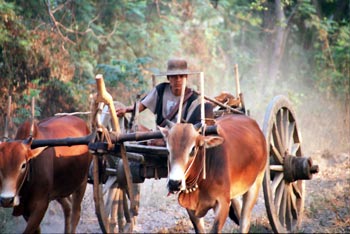
Today we go to Mandalay. There is no hurry and we leave late morning. I take a swim while Lwin locates more fuel then we are off. My guide is in top form. Houses, cars, buses, bicycles and trishaws whiz by like the chase scene in a silent movie. Charlie Chaplin on wheels! Here and there we stop, I shoot a few frames and off we go. Actually Lwin is quite willing to stop but it is often difficult to see an interesting shot as it is usually behind us by the time I make a decision to shoot it. Just the same I am seeing the real Burma.

Five hundred thirty miles in three days! Traveling six hours a day that means our average speed works out to just twenty-nine miles per hour. To me it feels like doing eighty in a fifty mile per hour zone. The average speed of automobile travel in the U. S. is perhaps forty five miles per hour. The average here in Burma is closer to fifteen. In a world that moves at one third the speed I am used to, doing thirty seems like flying. Still, six hours spent jouncing along old dirt roads, sometimes with sand just clearing the hubcaps in an automobile with fourteen-year-old springs, takes its toll. We revisit the idea leaving the car in Mandalay and taking the Sunday night flight back to Rangoon. This is an idea whose time has definitely come.

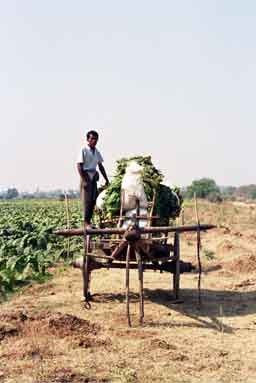
The sky is dark blue and cloudless. Not a hint of rain in the air. The landscape continues to be arid. We pass a series of irrigated fields. They are growing tobacco. The peasants use bullocks to plow up the dark mud. In one field the tobacco leaves are spread out drying in the tropical sun. The road alternates between tarmac and long stretches of dirt road. “This is the good road” Lwin tells me. Good?, I’d hate to see the bad but just then we reach it. The road will lead us to the main artery that runs between Rangoon and Mandalay. Finally we reach it. It is indeed nicely paved and would you believe, four lanes. Traffic is sparse. “This is more like it”, says Lwin, “now we can do one hundred forty km.” We pass an American style toll both with about eight lanes, a gate and a little metal booth at each one but the toll booths are empty, the little booths sit lonely in the sun. No doubt built with foreign aid. We just maneuver around it and continue on our way.

Life Along the side of the highway is little different from that along the secondary roads we have been traveling . No mega gas stations, no fast food malls. The closer we get to larger population centers the more trucks and motorbikes we see. Along the country roads, the people were almost always on bicycles and trishaws. Goods and people move by human muscle power.

We arrive in Mandalay at about One o’clock. Mandalay is a large city with broad streets and avenues. The streets are well kept and have names like "66th".

We stop at Lwin’s favorite restaurant. I know the drill: pick and pick out my dishes at a glass walled counter. They are brought to our table along with a steaming mound of fluffy white rice. We order fresh squeezed lemonade from a stall just outside. I decide on mutton balls, Lwin orders fish. Each is served with several dishes of condiments, tomato, chili, bean dip and a plate of raw vegetables. I pick up a long green pealed vegtable that . looks like a kind of squash and tastes like it too. Lwin offers me a slice of peeled green mango; the taste is very much like lemon.

Mango is a favorite of mine. The rich creamy fruit was just coming into season in Thailand when I arrived. I enjoyed several during my stay in Bangkok. Unfortunately mango is out of season in Burma.

Soup is always part of the meal. It bubbles away in a huge iron cauldron. I am not sure what the soup base is but kale is a major ingrediant.

Cheap nourishing soups are a staple in Asia. Bowls of hot, tasty soup can be purchased at tiny wooden wagons in Thailand, Soba houses in Japan, and funky open fronted restaurants in rural Burmese towns. The smell of boiling stock fills the air on early morning walks along the klongs and back alleys of Bangkok. A version of it has been on our table at each meal. It is hot and tangy and is slurped along as part of the main meal. If you can’t afford anything else you can always live on soup.


Tomorrow, Lwin promises, several of his miner friends will make the trip down from Mogok to show us stones. Stay tuned...


Want more? Read on: www.secretsofthegemtrade.com
Free sample chapters then buy the book!


Labels: , , ,

Monday, August 07, 2006

The Making of a Masterpiece


The Making Of A Masterpiece:

By Richard W. Wise, G.G.

©2006

Step 1: The Gem:

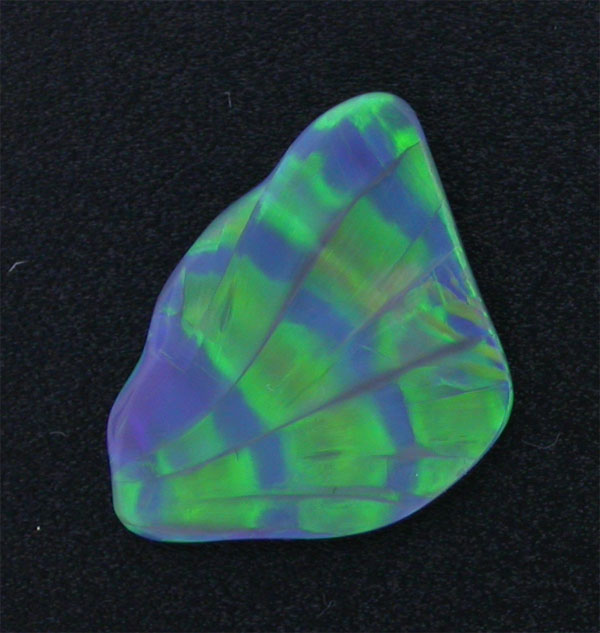
Recently a client fell in love with this unusual and fine black opal (left). Black opal is found at Lightning Ridge in New South Wales, Australia and almost nowhere else. The cutter, Christine Roussel, noting the unusual color pattern in the stone cut it to resemble a butterfly’s wing. We all agreed that the best use of the gem would be to make a butterfly piece, in this case a pendant for his wife. A combination brooch/pendant would have added flexible but as his wife never wears pins he decided against a combination piece. Few people have ever seen the steps necessary to produce a fine handmade original so we decided to document the making of this masterpiece.

Step 2: The Concept:

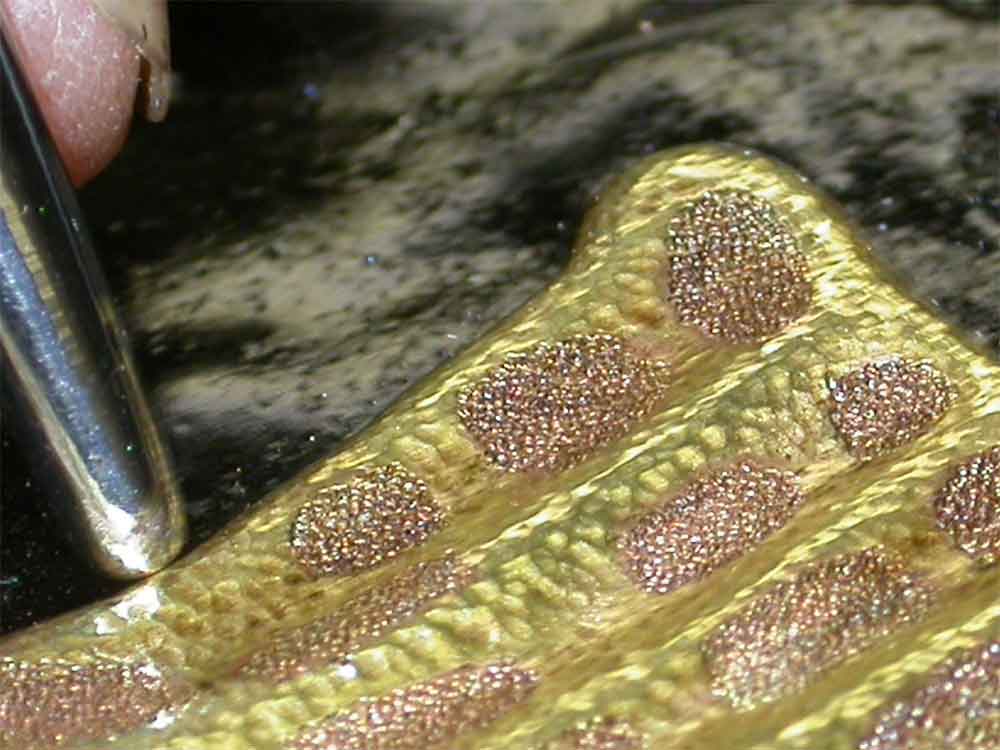
Goldsmiths often rely upon a particular gemstone to stimulate the creative juices. In this case, our chief designer, Douglas Canivet executed a number of sketches or studies for our client. Once the client approved the concept, we decided to make a full color rendering to give us the flavor of the finished piece. For dimensionality it was decided to execute it using the ancient repoussé technique. The French word means literally “to work from the back”. The result is a bas-relief when the piece is viewed right side up. The client decided that the body and wing of the butterfly would be executed in a combination of 18k yellow and rose gold. For contrast and strength, the antenna and feet would be made in platinum wire.

Step 3: Execution:

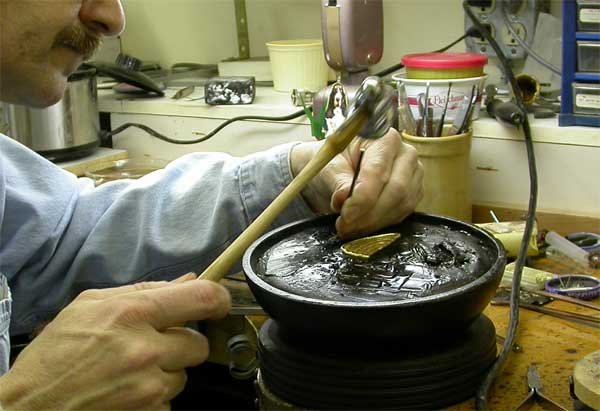
To render a concept is one thing to execute it is quite another. First, a template is made and each of the components is cut out with a jeweler’s saw. Rose appliqués are applied to wing and the wing and body components are pressed into an iron bowl filled with warm pitch. Once cooled, the pitch holds and provides a flexible cushion for the metal. . Set in pitch steel punches can be used to sculpt and expand the metal. Although gold is the most plastic of metals, the cushioning effect of the pitch is necessary to prevent the steel tool from slicing through or cracking the gold.

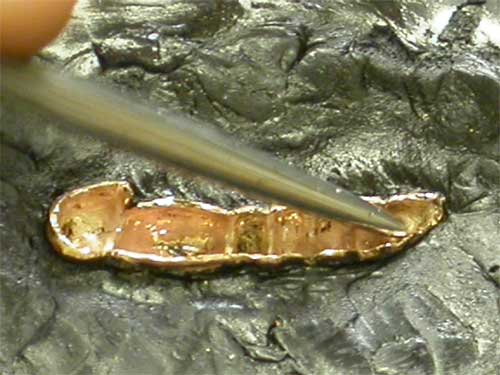
A bezel is made to hold the gem. The bezel is simple speaking a box made to hold the stone. It must conform exactly to the shape of the stone (no easy task with a wing shaped stone). Later, the edge of the metal is pressed up against the gem to hold it securely in place. Pictured (left) is the finished body, wing and bezel. Note the rose colored spots in the wing shape, the result of the shaped pieces of rose that was applied to the yellow gold. Repousse work also produces a beautiful textured patina that is much appreciated by connoisseurs and collectors of fine jewelry. The image (right)shows the finished body, wing and bezel.

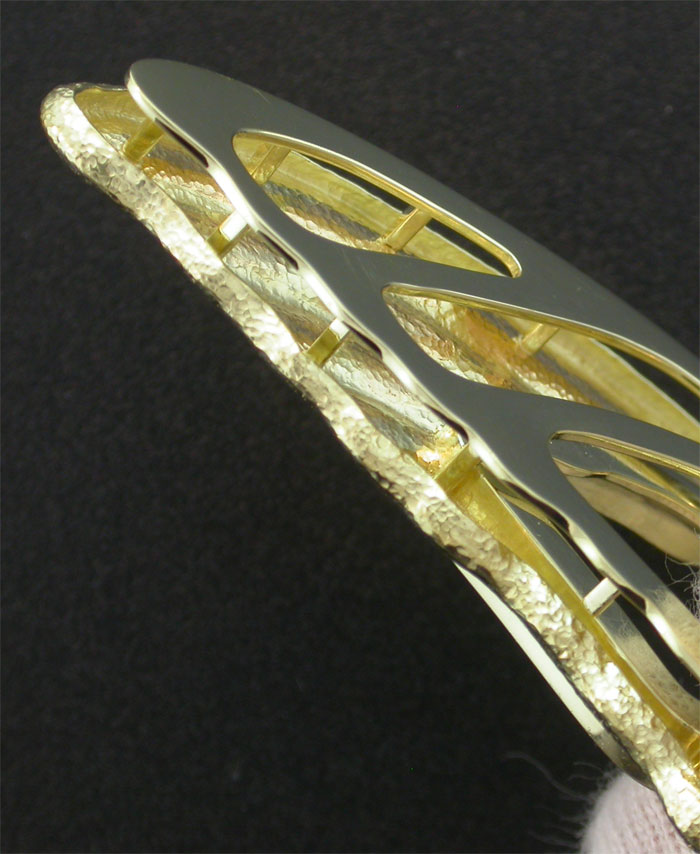
The next step is making of the gallery. One of the ways for a collector to quickly determine if a piece of jewelry is of the ultra-fine class is to flip the piece over and examine the back. Traditionally the finest jewelrythe reverse is completely finished. A finely made gallery such as this one, carefully cut out of 18k gold with a jeweler's saw, provides the piece with a finished look but allows the repousee work to be seen. The gallery is fitted to and raised slightly above the reverse of the piece like a sandwich and held in place with each post soldered.

Just before the gem is set, the antenna and feet that have been carefully shaped and fitted are soldered into place. The next image (below) shows a cross section of the piece with the gallery soldered in place.


Step 4: Set & Finish:


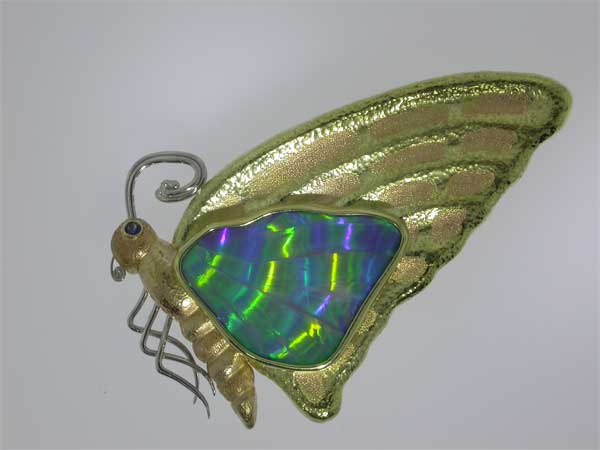
Setting the gem is always the last step. With opal this can be a particularly nerve wracking one. Opal is a brittle stone so the setting must be accomplished with great care. One slip of the steel tool and disaster. In this case Mr. Canivet's hand remained steady. Opps, lets not forget the sapphire eye. And the finished piece, well you be the judge. Note the patina on the wing and body and the finely crafted antenna and feet. Does it look like the sketch, well if you like it in paper and pencil how can you not love it translated into gems and gold!

In our 28 years we have designed and executed over 1,000 custom pieces for our clients. For us it is the essence of the creative process and the best part of all is when the client gets his first glimpse of a masterpiece. A gallery of our handmade original pieces can be found at www.rwwise.com


Thursday, August 03, 2006

Burma Journal; On The Road To Mandalay, Part II

By Richard W. Wise, G.G.

©2006

Day Two:

After a good night’s sleep we are up and on the road early. The morning is cool, the air sweet like early New England summer, the heat doesn’t become oppressive until about noon. Until then we tool along with our windows rolled down, saving our air conditioning and fuel. I am feeling good and ready to take photographs so we stop several times along the road.

In one small town, Lwin pulls over. There is a wedding in progress and he stops for me to take few shots. I am immediately accosted by one of the guests who insists that I come in and take a picture of the bride and groom. The music stops, I am shown a seat. Tea, cakes and a pack of cigarettes appear on the table before me. I am embarrassed, upstaging the young couple on this their most important day. They seem bemused and not at all pleased. They are young, perhaps fourteen, and sit solemnly on a small raised stage in the front of the hall, he in a white suit, she in a wedding dress. So I smile, take a few photographs, bob my head up and down, mouth inanities, thank the guests and back the hell out of there.

The landscape becomes increasingly arid as we move along the second leg of our journey. The tarmac ends and we are on a narrow sandy dirt road. It looks like drought.

The fields are dusty and flat and the clipped dry grass rolls out toward the horizon in all directions. The trees are devoid of leaves with knarled brown fingers clutching at the sky. Even the peasants working their fields have changed their color from dark copper to light mocha brown. They are preparing their fields but planting must wait for the rainy season that is nearly six months away. We stop for lunch in a restaurant in a small rural town called Kwajo.

Our second night finds us camped out in a small hotel on the banks of the Irrawady River. It’s called the Bagan Thande. Fifty-two bucks a night payable in U. S. Dollars of course. Lwin gets off much cheaper paying about fifteen dollars in the local currency. Foreigners in Burma are officially required to pay for hotels and so forth in dollars and, due to the embargo, no credit cards are accepted.

Much of our second day’s travel his been within site of the river. We can see mist shrouded mountains lining the far bank. The golden dome of a pagoda sparkles in the afternoon sun. Barges and small freighters ply their trade along the river. We have our dinner and breakfast in a garden setting along the riverbank with the welcoming limbs of a giant Acacia spread in a canopy above us.

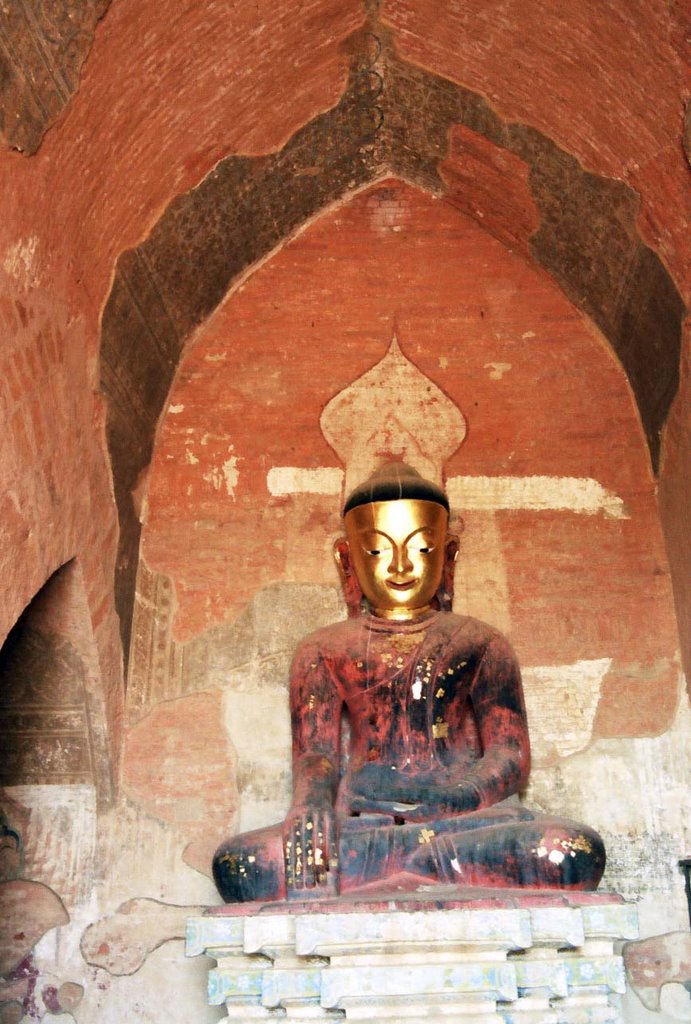
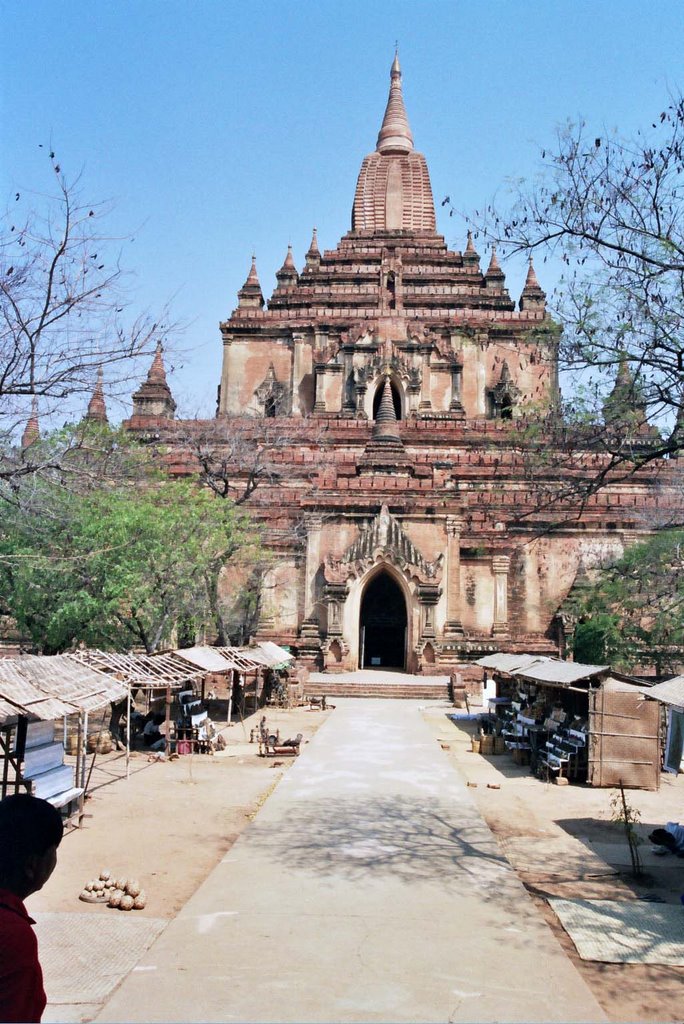
On the way into Bagan we visit our first Pagoda. This one, built in 1183 is, like most, a square layered wedding cake built of red brick with plastered interior walls. The bricks are artfully joined, a testament to the craftsmen who built them. The temple has several giant Buddha statues. The vaulted passages that run the circumference are long and dark and the walls are frescoed with paintings of dragons, mythical monsters and devotees in attitudes of meditation. Arched windows have been placed at all points of the compass but they do little to mitigate the baking heat of the late afternoon. To my guide’s disgust, many of the frescoes have been inexpertly restored. This is the work of the generals “who are not educated men” and insist upon reconstructing much of the ruins which Lwin rightly believes should be left alone.

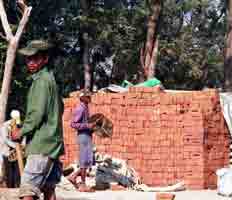
There are hundreds of these old temples scattered about the parched landscape, each with its reddish brown phallic tower thrusting up into the sky. Each king sought to out due his predecessors and at the same time purchase himself merit in the next life by building the biggest and best. There are so many, they form a skyline. When I look at these monuments I do not see devotion or piety, rather these seem to me to be monuments to the inflated egos of the monarchs who had them built and to the toil and sweat of those forced to labor in their construction. Perhaps I am wrong. Could be that these ancient craftsmen were grateful for the employment or they were pious men who believed they were building up their own karmic merit to ease their way into the next life; however, I am told much of the construction was done with forced labor. I can see the workers bent over stripped to the waist, the dripping sweat cutting stripes along backs and chests stained red by the red clay dust, placing brick after brick; day upon weary day and to what purpose? We visit four more pagodas, each little different from the last. Just another pile of bricks! The architecture of each pagoda seems tiresomely similar, but then I find much of Asian art, particularly Buddhist art, repetitious and devoid of individuality. I am thinking of a verse from the Upanishads:

“He who sees diversity goes from death to death.”


Enjoying this taste of gem adventures? Interested in reading more? I have traveled to most of the major gem producing areas in Asia, Africa, Australia and Latin America. You are cordially invited to travel with me to some of the most remote areas on earth in search of the world's finest gemstones. Read a free chapter of Secrets Of The Gem Trade, The Connoisseur's Guide To Precious Gemstones: www.secretsofthegemtrade.com


Labels: , , ,

Enter your email address:

Delivered by FeedBurner