Showing posts with label cuprian Paraiba. Show all posts

Wednesday, February 11, 2009

Drama In The Desert: ISG Seminar---A Dry Hole!


Drama In The Desert: ISG Seminar--A Dry Hole:

by Richard W. Wise, G.G.


The much ballyhooed "Epochal Crisis" never quite materialized at the International School of Gemology's "Let the Science Speak" seminar held February 6th at the Arizona Hotel. In a rambling presentation, ISG President Robert James
back-pedaled on some of his previous statements and presented the results of advanced tests that contradicted his own theories.

The silence was eerie. It was painful to watch. Thanks to Colored Stone Magazine's drum beating, the talk was attended by a who's who of gem scientists. James' attempts at folksy humor fell flat. The scientists sat quietly and listened to the presentation of evidence. After the presentation, they politely applauded, asked few questions and filed out, leaving Robert James' reputation as a gemologist in a heap of smoldering ruins.

In a series of internet broadsides last September, James made sweeping claims that large amounts of Mozambique cuprian, as well as other tourmaline, were being subjected to copper diffusion treatment. Recently he c
ast his net wider, suggesting that what he now calls Grain Boundary Diffusion, is being used to improve the color of not only tourmaline, but garnet and topaz as well.

Goop In The Tubes:

The presentation centered on what James called "goop in the tubes." Hollow growth tubes are a characteristic tourmaline inclusion. What James finds telling is the fact that in some Mozambique tourmaline, these tubes are filled with a yellow-red substance that James cannot identify. In a previous GemWise blog, serious questions concerning these claims were raised by John Koivula and Christopher Smith, questions that James failed to address. In a significant variation on last September's theme, James has now backed away from his claim that the filling material is copper. In fact, he carefully avoided using the term copper diffusion throughout the lengthy talk.

James showed slides showing what he calls diagnostic "footprints" which prove treatment. However the footprints he finds in topaz do not in the least resemble the "footprints" he finds in tourmaline. His tourmaline slides showed straight growth tubes; his topaz slides showed a spider web of tiny lines. He presented absolutely no proof of diffusion in tsavorite garnet; he simply suggested that the appearance, in the past decade, of tsavorite over two carats is ominous. He never explains how that relates to his diffusion theory. Last September, he claimed he discovered that undisclosed amounts of synthetic tourmaline were being sold, but now admits that he was wrong. (image right: large chunks of tsavorite rough from a 2007 strike at the Scorpion Mine, Voi, Kenya, that yielded several stones above 10 carats. Courtesy: Tsavorite USA)

The conclusions drawn from the advanced testing promised last September conclusively demonstrated that James understands neither the characteristics of his test material, nor the diffusion process itself. According to James, LA-ICP-MS testing (commonly called laser ablation) conducted by Evans Analytical showed differing concentrations of manganese and iron in the tourmaline samples tested, with higher concentrations toward the center of the specimens. James suggests that this is another "footprint" left b
y the treatment process, and fails to note that the characteristic color zoning in tourmaline is the result of compositional differences within the stone. For example, higher concentrations of manganese produce richer pink zones in tourmaline. In a later Q&A session, when the soft-spoken Dr. Adolf Peretti, former head of the Gueblin Lab and President of the GRS Lab in Bangkok, told him flat out that varying concentrations of elements are characteristic of natural tourmaline, James suggested that Peretti's test samples had been altered by diffusion. (photo left: Gemology 101, a natural "footprint" crystal cross-section: pink color zone caused by concentrations of Mg. in the center of the crystal. Similar images exist in the literature going back 150 years)

How Diffusion Works:

Diffusion is the word currently bandied about, but what is it, what does the term mean? Let me share with you an analogy suggested to me by one of the world's leading authorities on the use of diffusion treatment in gemstones:

Consider a dollop of blue ink dropped into a glass of water. The ink will slowly diffuse throughout the water, eventually turning the water a uniform light blue. Ion diffusion, or deep diffusion, works exactly the same way. Diffusion moves from higher to lower concentrations. Just as the ink does not remain concentrated, outside substances such as Beryllium and copper, when introduced into gem material, spread out and diffuse throughout the material. The ions do not concentrate as James suggests--concentration is the result of slow natural crystal growth and results in zones of color, a common trait in tourmaline. Thus, James' advanced testing proves, as Dr. Piretti and Dr. Kiefert have pointed out, exactly the opposite of James' contention. Concentrations of manganese and iron in tourmaline prove that the color is natural.


Industry writer and James acolyte David Federman has been warning for months that James' presentation would spark what he terms as an "epochal crisis" in the gem trade. Abandoning any pretense of objective journalism, he has written three articles praising James and ignoring prominent scientists such as John Kiovula, Richard Hughes, Christopher Smith and Ted Themelis who profoundly disagree with James' methods and conclusions. In the current Colored Stone, Federman says we are living in "gemological end-times." What did all this apocalyptic rhetoric amount to? What James actually presented was mostly old, largely discredited information that although full of sound and fury, flies in the face of science and logic and proves his own theory to be totally false.

AGTA and GJX:

There was definitely more action at the gem shows, but then gems are the major reason most people are here in Tucson during this two-week period. Most dealers I interviewed said that sales exceeded their expectations, though they didn't say what those expectations were. All signs point to a tough year ahead. As dealer Chris Johnston pointed out, its a Darwinian crisis, and as usual, the strong will survive.


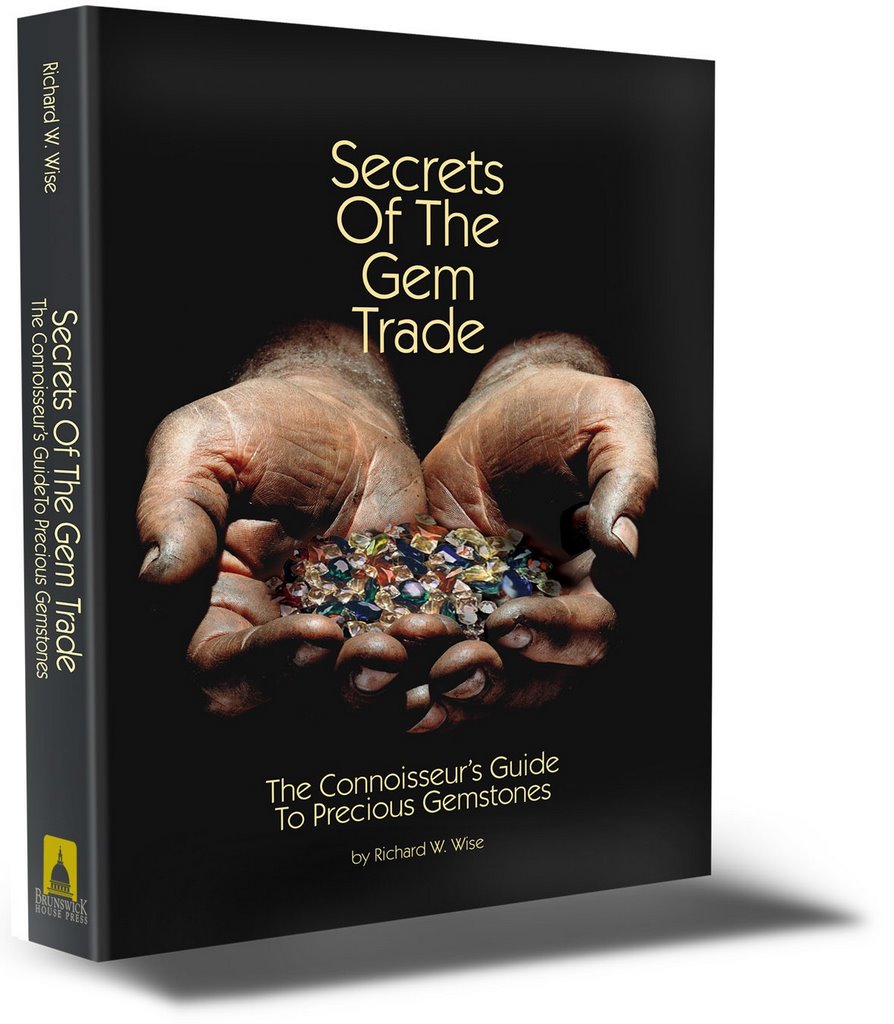
Visit Burma's Valley of the Serpents and learn how sapphire is mined and graded. Follow me on gem buying adventures in Burma, Thailand and Sri lanka. Visit the gem fields of Australia and Brazil. 120 carefully selected photographs showing examples of the highest quality gems to educate the eye, including the Rockefeller Sapphire and many more of the world's most famous gems. Consider my book: Secrets Of The Gem Trade, The Connoisseur's Guide To Precious Gemstones.


“Wise is a renowned author... He’s done a marvelous job of this first book
, monumental work, a tour de force...My recommendation: Buy this book”.
Charles Lewton-Brain, Orchid


whether you like to know what the best colour is in Tanzanite, or how to grade a Diamond, you will find it in this book. No other book I read before dealt with this topic is such detail as Richard Wise's masterpiece."

A. Van Acker, FGA
Amazon June 2005

"Secrets Of The Gem Trade: The Connoisseurs Guide To Precious Gemstones by Richard W. Wise is an impressive new reference for dedicated dealers and collectors of gems, gemstones, and ... pearls. Introducing and descriptively exploring each and every gem covered in the easy-to-use reference, Secrets Of The Gem Trade contains an illustrated summary of each stone inclusive of its history and general information, hue and tone, saturation, which may be noticed as the finest, an understanding of the particular gems rarity, and the caution for synthetics and how to depict them, however depending upon the stone there may be description of clarity, color fading, multi-color effect, etc. Secrets Of The Gem Trade is very highly recommended to anyone interested in gemology as a superbly organized, authoritative, comprehensive, and easy-to-follow reference."


Midwest Book Review
April 2006

Only $39.95 in paperback. Read a couple of chapters online an order: We recently discovered about a dozen copies of the out of print hardcover: $79.95 signed by the author www.secretsofthegemtrade.com.

Buy it on Amazon: www.amazon.com

Wednesday, September 24, 2008

Copper Diffusion; Is It Gemology's New Worst Nightmare? Part I

By Richard W. Wise, G.G. ©2008

The Latest From Bangkok?

Rumors are reverberating through the gem trade that gem alchemists in Thailand have developed a method to diffuse copper into tourmaline. This method converts low-end pale blue tourmaline into highly saturated material similar to the high priced cuprian tourmaline currently coming out of Mozambique. The first salvo was fired by Ted Themelis a well known expert on gem treatments and repeated in an article by David Federman in Colored Stone Magazine. One of my sources, a dealer active in Bangkok, wrote me two weeks ago claiming that some of this material had actually been certified as cuprian or “Paraiba” type tourmaline by an unnamed gem laboratory. (image above left; gemologist John Koivula lectures at the World of Gems Conference, Chicago)

Adding more fuel to the fire, just as I was about to leave for the World of Gems Conference (WOG) in Chicago, Robert James, FGA, President of The International School of Gemology (ISG) released a study that suggests that tourmaline, even some of the pricey Mozambique cuprian tourmaline is deep-diffused with copper to improve its color. The conference was abuzz with Mr. James’ contentions. Though deep diffusion was not on the agenda, everyone seemed aware of the article and James conclusions were much discussed. Unfortunately, James, who had planned to attend, was unable to due to Hurricane Ike.

This is James’ second broadside in a series. In the first installment he published a study that he says proves that Andesine is being bulk diffused with copper. Many of the gemologists I spoke to in Chicago expressed admiration for the James chutzpah while at the same time questioning both his methodology and conclusions. Stuart Robertson, Research Director of Gemworld International summed up the views of many of the gemologists attending the WOG Conference: “his conclusions on andesine may be right, but his science is flawed. He is way off base on tourmaline.”

Andesine Diffusion Has Arrived:


"Ive been able to turn it red in the lab."

Dr. John L. Emmett

“I’ve done it” said Dr. John Emmett said in an interview just yesterday when I asked about copper diffusion in andesine. “I’ve been able to turn it red in the lab and made some that look like a good ruby.” The real issue says the former associate director of the Lawrence Livermore Laboratory is differentiation. Emmett, whose firm, Crystal Research, specialized in heat treating Montana sapphire, has tested labradorite from all the major sources, including Oregon sunstone and Mexican material from the Casa Grande mine. "There is natural labradorite, heated labradorite and copper diffused labradorite." The question now is how do you tell the difference? Emmett prefers the term labradorite to andesine because, he says, the demarcation between the two is completely arbitrary.

Studies of this kind are normally done in well equipped gemological laboratories and subjected to a long process of peer review. Preliminary findings are submitted to colleagues, methods and are minutely scrutinized and conclusions challenged. This time consuming process works to the benefit of the scam artists. Gemologists are put in the position of always playing catch up. Why is this the case?

"Gem labs are sitting there fat, dumb and happy.”
Dr. John L. Emmett

"The problem is, gemology is an observational science not an experimental science", Dr. Emmett stated. "Gem labs are sitting there fat, dumb and happy.” No one is doing the research. If GIA had put together a small research team in the 80s when surface diffusion first became an issue they would have discovered all the possibilities and would have been able to identify the possible diffusion treatments before the Japanese bought 100 million dollars worth of Beryllium diffused padparadascha sapphire.

Peer Review Goes Public:

James decided to shortcut the review process and has courageously or foolishly, depending upon your point of view, chosen to go public before completing his research, opening himself to a potentially painful process of public review. As luck would have it, several of the world’s leading gemologists; John I. Koivula, Chief Gemologist at The Gemological Institute of America (GIA), Dr. Lore Kiefert, head of the AGTA lab were in attendance and I took the opportunity to raise the issue of tourmaline diffusion with them and a few others. Stay tuned!

R. W. Wise Unveils New Website:

Finally the new website is up and running. We can boast a number of updated features:

The new site is quicker loading. The homepage looks more like a newspaper front page with a changing array of new designs from our workshop and a monthly featured gemstone.

One Click Access:

The search function at the top of the page allows you to navigate to any part of the site with a single click. You can view our entire gem, contemporary or antique jewelry inventory or go right to rings.

Multiple Large Product Images:

Now you can see the jewelry top, front and back. Gemstones sport multiple image much larger than the old site. You can really get a sense of the gemstone., multiple larger images of each gem.

Prices too...

We love to talk to our gems and jewelry and I doubt that anyone is going to buy a fine piece of jewelry or a gemstone without having questions. Still no market basket and we will maintain this policy of not pricing our finer pieces, but many pieces will now be priced. We have also updated the query form and will be pleased to call you with information. Take a look: www.rwwise.com


Visit Burma's Valley of the Serpents and learn how sapphire is mined and graded.

Follow me on gem buying adventures in Burma, Thailand and Sri lanka. Visit the gem fields of Australia and Brazil. 120 carefully selected photographs showing examples of the highest quality gems to educate the eye, including the Rockefeller Sapphire and many more of the world's most famous gems. Consider my book: Secrets Of The Gem Trade, The Connoisseur's Guide To Precious Gemstones.

“Wise is a renowned author... He’s done a marvelous job of this first book, monumental work, a tour de force...My recommendation: Buy this book”.

Charles Lewton-Brain, Orchid

whether you like to know what the best colour is in Tanzanite, or how to grade a Diamond, you will find it in this book. No other book I read before dealt with this topic is such detail as Richard Wise's masterpiece."

A. Van Acker, FGA
Amazon June 2005

"Secrets Of The Gem Trade: The Connoisseurs Guide To Precious Gemstones by Richard W. Wise is an impressive new reference for dedicated dealers and collectors of gems, gemstones, and ... pearls. Introducing and descriptively exploring each and every gem covered in the easy-to-use reference, Secrets Of The Gem Trade contains an illustrated summary of each stone inclusive of its history and general information, hue and tone, saturation, which may be noticed as the finest, an understanding of the particular gems rarity, and the caution for synthetics and how to depict them, however depending upon the stone there may be description of clarity, color fading, multi-color effect, etc. Secrets Of The Gem Trade is very highly recommended to anyone interested in gemology as a superbly organized, authoritative, comprehensive, and easy-to-follow reference."

Midwest Book Review
April 2006

Only $35.95. Read a couple of chapters online: www.secretsofthegemtrade.com.

Buy it on Amazon: www.amazon.com


Saturday, October 21, 2006

Mozambique Cuprian Tourmaline, Part III


Mozambique Cuprian Tourmaline, Part III


Purple Cuprian; A dilemma:

By Richard W. Wise, G.G.

©2006


“I know what you're thinking. Did he fire six shots or only five? Well, to tell you the truth, in all this excitement, I've kinda lost track myself. But being as this is a .44 Magnum, the most powerful handgun in the world, and would blow your head clean off, you've got to ask yourself one question: Do I feel lucky? Well, do ya punk?”


Clint Eastwood


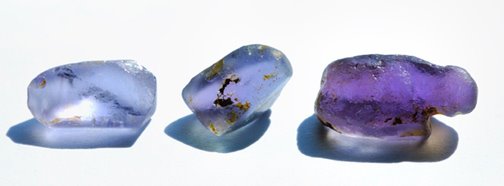
As tourmaline aficianados know, there are few truly rare colors of tourmaline. A pure yellow without a stong green secondary hue is quite rare and I have never seen a true violet but until recently, purple was the one spectral color that absolutely did not exist in tourmaline. Yes we had purplish reds but until last year when the Alta Lighona tourmalines from Mozambique entered the market, never a stone with a purple primary hue. (pictured above: 15.5 carat purple Mozambique cuprian tourmaline courtesy Pala International)

In early 1989 when the first curpian tourmalines from Paraiba appeared in the market in Brazil some were sold unheated. Most of these stones were a dark toned greenish “sapphire” blue, a “Thai sapphire blue” to be precise. In those days, blue was the most expensive, elusive and sought after color in tourmaline. Rumors whispered of a pure blue gem that was reputed to rival the finest in Burmese sapphire. This was the holy grail of tourmaline. I recall holding on to one parcel of natural dark blue Pariaba for several years before I burned them just in case the demand for the medium electric blue proved to be a passing fancy. Well, as we know it did not and when I finally did heat it, the result was a half dozen pure medium toned visually pure Carrribean blue gems that I sold at a substantial profit.

Since that time I have seen many examples of blue tourmaline including the famous Manoel Mutuca (described by Proctor as “sapphire blue” see Gems & Gemology, Spring 1985, p.11)) and Santa Rosa material but none (at least so far) with a true pure blue hue. Blue tourmaline always has a distinct greenish secondary hue which becomes quite evident when it is compared stone to stone with fine sapphire. Blue tourmaline can be exceptionally beautiful but it looks like tourmaline not sapphire.


To burn or not to burn or "Do I feel lucky? Well, do ya punk?”


With the entry of Mozambique curprian tourmaline we have a dilemma similar to the situation with the early Brazilian curprian tourmaline namely that some of the unburned material has a rich pure purple hue that reminds one of Siberian amethyst or fine purple sapphire. The difference is that unlike the rather dull greenish blue unheated Paraiba, this stuff is beautiful,

The Mozambique purples have a hue that is rich and pure. So, to burn or not to burn, that is the question, according to both Gene Flanigan from Precision Gems and Josh Hall at Pala International, these deep purples are also the best candidates for the oven, they heat to a neon pure medium “Paraiba” blue.

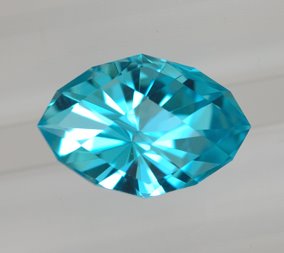
Some dealers have chosen the obvious solution. If you want a pure purple but burnable stone they will charge the same price as for the neon blue.(pictured above: unheated cuprian rough from Mozambique). Pictured below is an exceptional 1.89 carat custom cut Carribean blue cuprian stone cut from the center piece of rough. After and before; the first image shows the cut stone before heating. The second image shows the stone after the heating process was completed. The stone, currently available for sale at www.rwwise.com was cut by Gene Flanigan a very talented lapidary artist from upstate New York. (Images courtesy Gene Flanigan: www.precisiongem.com)

Will purple tourmaline go the way of fine star sapphires that hardly exist anymore because they can be burned and faceted? I don't think so, some of the fine purples simply possess problematic inclusions that make them risky candidates for burning. I found an 8.19 carat oval, a lovely example of Mozambique purple on my last trip to Asia. This stone faces up clean but under magnification shows long growth tube inclusions and cannot be burned. It is out having its picture taken and will be posted in a later blog. Logically purple cuprian tourmaline will have a two track price structure. Stones with a high degree of clarity under the loupe will sell for prices that may be double that for stones with certain types of inclusions whether visible or not.

Bits and Pieces:

I get lots of emails. Don't think I'm not grateful. Every once in a while a real interesting one comes through the mailbox. take this on:

Position Available:

Dear Mr Wise,
We are Stargate, diamond trading division of Ebenhaezer Bank Consulting Group of Belgium, operating in thirty countries worldwide. We have read your blog regarding the appraisal of stones by qualified experts. We have constant need of qualified gemologists, expert in assessing ROUGH DIAMONDS, and have great difficulty identifying where they can be located.
We offer good working conditions, contracts, and a fair remuneration.
A special need has arisen in Bangui, Central African Republic, where we are currently (this week) accepting a large consignment. We require the services of a qualified gemologist, expert in rough diamonds, to assist our team there.
Would you be kind enough to assist us at your earliest convenience?

Yours sincerely,
Lucilla Arioti
Global Client Relationship Manager, EMEA
Stargate,
a division of Ebenhaezer Bank Consulting Group
Telephone: London +44 207 870 5389

I am not familiar with Stargate but believe the lady is serious. She even called and left a message on my machine. So if you are a gemologist in search of adventure give Lucilla a jingle. This time next month you could looking at sparklies and sipping pina colodas in beautiful downtown Bengui. As for myself I'd love to go along but I can't give up my day job but when you get there be sure to drop me a line and oh do
be sure to take along a flack jacket.

New Site with excellent online library of inclusions:

Got an email from a French gemologist:
Marie-France Boursier-Brard. Ms Boursier-Brard has developed an excellent site with online images of inclusions. The site is quite comprehensive and well organized. Just click on: www.gemmes-inclusions.com


Check out my book Secrets of The Gem Trade; The Connoisseurs guide To Precious Gemstones: www.secretsofthegemtrade.com.


Now at 30% off just $27.95

"This book takes a much-needed sledgehammer to the industry's conventional wisdom about what makes a gemstone precious, and in the process builds a solid foundation for anyone who wants to understand the true beauty and value of gemstones."

Morgan Beard
Editor-in-Chief Colored Stone Magazine