Showing posts with label Baroda Pearls. Show all posts

Saturday, February 28, 2009

Tucson 2009 Wrap Up


by Richard W. Wise, G.G.

©2009 (all rights reserved)


Rubies From Winza, Tanzania:


As promised, here is an image of the 4.10 carat cushion shaped ruby from the new strike at Winza, Tanzania. Ruby from this source contains iron, though not as much as gems from the now exhausted Thai deposits. Stones from this source will not fluoresce strongly in ultraviolet light and thus will not exhibit the supercharged fluorescence of the very best from Burma. Again, due to iron, the red may show a slightly orangy secondary hue.

That said, natural unenhanced rubies over three carats are almost unobtainable. These new Winza beauties will stand toe to toe with most Burmese at a much more reasonable price.

An Extraordinary Strand of Natural Pearls:

I spotted a magnificent strand of natural pearls from a dealer at AGTA. What makes this two strand exceptional is its symmetry. When considering natural pearls it is necessary to bracket all that you have come to expect from their cultured counterparts. The word round, for example, takes on a whole new meaning when applied to naturals. We have gotten used to the "perfection" of the ubiquitous Akoya pearls from Japan, perfectly round, with matching color. Few realize that all this is a result of processing; the pearls are left in the shell just long enough to deposit a thin coat of nacre, so thin that GIA had to redefine it's definition of "thick" coating from 0.50 to 0.25mm. The pearls are then bleached white to remove spots, then further bleached for uniformity of color, then dyed pink.

The World Of Fantasy:

In the world of natural pearls, perfect symmetry, combined with matching color, resides in the realm of fantasy. The strand pictured right is natural, the pearls graduate from 4.31-9.50mm, each is perfectly round and well matched in color and luster. Compare these two with the Baroda Pearls (pictured left). Readers will recall that the Baroda strand sold at a world record price. A cursory look reveals that these magnificent gems are not really round---yet they achieved a record of $7.1 million at auction.

Secrets Of The Gem Trade Goes To Third Printing:

Brunswick House Press has just announced that the paperback edition of my Secrets Of The Gem Trade, The Connoisseur's Guide To Precious Gemstones is being reprinted. Originally published in hardcover in 2003, now with 32,000 copies sold, Secrets has become a best seller. "Secrets has succeeded beyond our wildest expectations." said Dick Sage, President of Brunswick House.

We have a few copies available at R. W. Wise, but the publisher will not be able to fill wholesale orders until the new edition arrives in about 90 days.

Notable Quotes:


“Since radiation is the cause of pink color in tourmaline, the presence of these features should not be attributed to any type of intentional diffusion, but rather to the influx of radioactive fluids in their post-growth environment.”

John I. Koivula, Chief Gemologist, GIA


"THERE ARE NO PROVEN EXPERTS ON THIS SUBJECT OUTSIDE OF ROBERT (James) EXCEPT TED THEMELIS WHO HAS ALREADY CONFIRMED ROBERT’S FINDINGS. SHOW ME ONE PERSON OF ANY STANDING WHO HAS DONE THE AMOUNT OF RESEARCH THAT ROBERT HAS USING ADVANCED ANALYTIC TECHNOLOGIES AND I’LL LISTEN. GIA’S PRESS RELEASE WAS BASED ON OLD-FASHIONED INFERENTIAL METHODS DERIVED SOLELY OR MOSTLY FROM MICROSCOPE OBSERVATION OF ONE STONE. ROBERT HAS TESTED THOUSANDS OF STONES. DUH!. SO IF THE PUNCH-DRUNK FIGHTER TO WHOM YOU REFER IS ROBERT, COME TO THE ARIZONA HOTEL ON FRIDAY,"I KNOW WHERE TO PUT MY MONEY. IT IS A HORSE RACE. AND THE ODDS ARE RUNNING STRONG AGAINST YOU (Richard Wise) AND THE GEMOLOGICAL ESTABLISHMENT. THAT’S WHY I HAVE REPORTED THAT THIS IS AN EPOCHAL GEMOLOGICAL CRISIS. CROSS-SPECIES DIFFUSION WILL PROVE OUR INDUSTRY’S EQUIVALENT OF THE SUBPRIME MORTGAGE CRISIS." (emphasis Federman, parenthesis mine)

David Federman, Editor-in-Chief, Colored Stone

by email 1/30/09


Colleagues,
"I read RJ (Robert James) newsletter forwarded to me by another colleague. As for as I am concern, RJ does not deserve my reply or any respect whatsoever. He is trying to tell us about his invention of the hot water using all kinds of tactics. In conclusion, it does not serve any useful purpose to discuss any longer RJs research activities. There are more important issues to discuss in the gemological forums. Let's move forward."

parenthesis mine!
_________________
Ted Themelis
Research & Development
Gem Treatment Lab
from Gemologyonline 2/13/09


Visit Burma's Valley of the Serpents and learn how sapphire is mined and graded.
Follow me on gem buying adventures in Burma, Thailand and Sri lanka. Visit the gem fields of Australia and Brazil. 120 carefully select
ed photographs showing examples of the highest quality gems to educate the eye, including the Rockefeller Sapphire and many more of the world's most famous gems. Consider my book: Secrets Of The Gem Trade, The Connoisseur's Guide To Precious Gemstones.


“Wise is a renowned author... He’s done a marvelous job of this first book
, monumental work, a tour de force...My recommendation: Buy this book”.
Charles Lewton-Brain, Orchid


whether you like to know what the best colour is in Tanzanite, or how to grade a Diamond, you will find it in this book. No other book I read before dealt with this topic is such detail as Richard Wise's masterpiece."

A. Van Acker, FGA
Amazon June 2005

"Secrets Of The Gem Trade: The Connoisseurs Guide To Precious Gemstones by Richard W. Wise is an impressive new reference for dedicated dealers and collectors of gems, gemstones, and ... pearls. Introducing and descriptively exploring each and every gem covered in the easy-to-use reference, Secrets Of The Gem Trade contains an illustrated summary of each stone inclusive of its history and general information, hue and tone, saturation, which may be noticed as the finest, an understanding of the particular gems rarity, and the caution for synthetics and how to depict them, however depending upon the stone there may be description of clarity, color fading, multi-color effect, etc. Secrets Of The Gem Trade is very highly recommended to anyone interested in gemology as a superbly organized, authoritative, comprehensive, and easy-to-follow reference."


Midwest Book Review
April 2006

Only $39.95 in paperback. Read a couple of chapters online an order: We recently discovered about a dozen copies of the out of print hardcover: $79.95 signed by the author www.secretsofthegemtrade.com.

Buy it on Amazon: www.amazon.com


Saturday, June 09, 2007

The Baroda Pearls; Another Auction Record at Christies


New Auction Record For Natural Pearls:

The April 25th Christie’s sale followed a now familiar patter of jaw dropping, world record prices for large rare gem. Previous records for Burmese Rubies and Kashmir Sapphires have been smashed. The Baroda Pearls (image left), a double strand of 68 natural pearls that were formerly the property of the Gawkwar of Baroda was auctioned along with matching brooch, earrings and ring for the record sum of 7.1 million dollars. At this same sale a 22 carat Kashmir sapphire also set a world record (see previous post).

In the 19th century, the maharajah of Baroda, Khande Rao Gawkwar, came to possess the necklace that became known as the Baroda Pearls, The necklace was among the most expensive pieces in the Baroda Royal Treasury and remained one of its prized jewels throughout the 20th century.

The 825 square mile former principality of Baroda is located in northwestern India 148 miles north of Bombay. In 1907 Tiffany’s gemologist G. F. Kunz described the Baroda holdings as “among the greatest jeweled treasures of India” and estimated that the total value of pearls held by the Gawkwar to be 12 million dollars. The original “Baroda” necklace was composed of seven matched and graduated strands and was examined by Kunz and estimated by him to be worth a half a million dollars.

According to Christie’s the current necklace is composed of two large strands made of pearls from the fourth, fifth, sixth, and seventh strands of the original, joined by a cushion-cut Cartier diamond clasp. The 68 graduated pearls match in color, luster, and shape. The previous record for natural pearls at auction was set by Christie's in Geneva in November 2004 at $3.1 million, for a two-strand natural pearl necklace.

Since about 1949, the natural pearl market was basically D.O.A (dead on arrival) though price lists like The Guide have continued to quote wholesale prices for natural pearls; there was essentially no market for natural pearls in the United States. Why, a combination of the Wall Street crash of 1929 and the emergence of the cultured pearl in the late 1920s. According to Elisabeth Strack author of Pearls the market fell by 85% in one day in 1930 when banks refused to accept pearls as collateral for loans to pearl dealers. I recall a conversation with David Federman in 2001 to the effect that this market was making a comeback.

Judging from at least one show in Tucson, the natural pearl is back. Several dealers featured natural pearls and natural pearl prices have experienced stratospheric price increases since the first record breaking auction sale in 2004. I had dinner with the Swiss dealer who brokered the Baroda Necklace. The next day he showed me a graduated double strand of white roundish natural pearls that he had on offer at 2 million dollars. According to this dealer the price of the strand had increased by a factor of ten over the past five years. Another savvy dealer, Jeremy Shepherd, President of Pearlparadise.com told me that the largest percentage increases have been in commercial grade natural pearls.

According to CIBJO rules a natural pearl is simply a “pearl” with no qualification required and the use of terms based on classic localities such as “oriental pearls” is also allowed.

Prices Up or Dollar Down in Las Vegas

As for prices for gems and jewelry, prices are up or as one dealer put it, prices are exactly the same for fine gems; the dollar has simply lost 35% of its value.


Interested in understanding more about the grading of fine pearls? Follow me on gem buying adventures in the pearl farms of Tahiti. Visit the gem fields of Australia and Brazil. 120 carefully selected photographs showing examples of the highest quality gems to educate the eye, including the Rockefeller Sapphire and many more of the world's most famous gems. Consider my book: Secrets Of The Gem Trade, The Connoisseur's Guide To Precious Gemstones.


“Wise is a renowned author... He’s
done a marvelous job of this first book, monumental work, a tour de force...My recommendation: Buy this book”.

Charles Lewton-Brain, Orchid

Only $39.95. Read a couple of chapters online: www.secretsofthegemtrade.com.

Buy it on Amazon: www.amazon.com

Thursday, September 14, 2006

Choosing The Perfect Pearl


Ten, make that eleven tips to help you choose the perfect pearl


by Richard W. Wise, G.G.

© 2006


1. There are two types of pearl, natural and cultured. In today’s market just about every pearl you see will be cultured meaning that the hand of man had something to do with the creation of the pearl. (pictured above a necklace of mixed South Seas white and golden pearls)

2. We are experiencing a pearl Renaissance. There are more types of pearls on the market today than ever before. Twenty years ago the Japanese Akoya stood virtually alone. Today you can choose from: Freshwater pearls, South Seas white, Tahitian black and South Seas golden pearls.

3. What’s the best buy in pearls? Probably the Chinese Freshwater, (pictured left 8.5mm round natural color Chinese f/w pearls) There are two ways to create a cultured pearl, bead nucleation and tissue activation. Pearls that are bead nucleated have a large bead made from shell and thin covering of nacre depending upon how long they are left in the mollusk. Chinese freshwater pearls are tissue activated, have no bead and are pure pearl. They are available in natural pastel or white and in their finest qualities have some of the characteristics of natural pearls. Be careful, over 90% of Chinese freshwater pearls are of marginal quality. The best will stand toe to toe with any pearl in the world and can be purchased for a third of the price. To help you in selection, pay careful attention to the following guidelines:

4. Pearls are often treated, usually to change or improve the color. Pearls are routinely dyed and irradiated. Natural colors are, by far, the most beautiful. Japanese Akoya, the pearl that is seen most in the market is routinely bleached white then dyed to give it a pinkish overtone. If the color looks too good to be true it probably isn’t.

5. A fine pearl has what experts call “life”. This is a combination of high surface luster and overtone and occasionally orient. All pearls exhibit luster, those with thick nacre will usually show excellent luster. Observe the pearl(s) on a white background under a light bulb, if you can distinctly see the outline of the bulb the pearl has high luster.

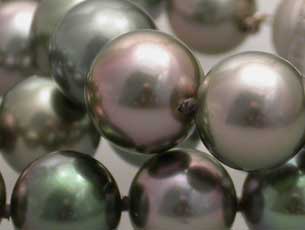
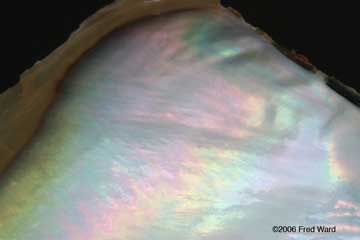
6. Some pearls exhibit an ephemeral misty glow that seems to hover over the surface of the pearl. This is called overtone. Not all pearls exhibit overtone, for example, it is very rare in South Sea white pearls. If present in white pearls, the overtone is usually pink, in Tahitian black pearls, green, red or blue or some combination (pictured right). Orient is rare in round and semi-round cultured pearls. Orient may be defined as a rainbow affect that changes as the pearl is rotated in the light. Orient is chromatic, meaning it will show all the colors of the spectrum whereas overtone is normally monochromatic exhibiting one color such as pink. A ball bearing can have wonderful luster but the addition of overtone or orient adds dimensionality and life to the pearl (pictured right: orient in Chinese f/w baroque pearls. Below (right) distinct orient in a pearl shell).

7. To judge if all the pearls in a strand are round, hold the strand taught between your hands and rotate the strand between your fingers. In a round strand you should see no movement but if some of the pearls jump about like the cams on a cam shaft, the strand is not completely round.

8. Odd shaped pearls, called baroques, are not to be disparaged. If they have good luster, no scratches or cracks they have a younger hipper look than the more expensive rounds. You can wear them with jeans and they are available at a substantially lower price.

9. Pearls have flaws just like other gem. These may be dimples, scratches or cracks. A dimple here or there should not be of much concern however, one that looks like it has a bad case of chicken pox should be highly discounted. A pearl with a deep scratch or crack is unacceptable.

10. Beware lower priced Japanese Akoya pearl, if your grandmother has a strand of white round pearls they are likely Akoya. These are formed by placing a shell bead in the oyster. In the last few years, Japanese farmers have dramatically reduced the time the pearl is allowed to develop in the shell resulting in pearls that are little more than nacre plated beads with less than ¼ millimeter of pearl essence or nacre over the shell bead. These pearls are often bleached then dyed pink to simulate overtone. These pearls lack luster and are prone to flaking.

11. Pearls come in many nuances of color but color is not the issue. It doesn’t matter how good the pearls look in the jeweler’s case, the real question is how the pearl looks against your (the wearers) skin. Pearls come alive when placed against skin of an appropriate color and texture. This is a characteristic I dubbed simpatico in my book: Secrets Of The Gem Trade, The Connoisseur’s Guide To Precious Gemstones. Don’t prejudge, test the simpatico of each strand by placing it against the skin on the inside of the wrist. The skin in this area is the same color and texture as the skin around the ears and neck. The result may surprise you.


Need more information on pearls?

Follow me on gem buying adventures in the pearl farms of Tahiti. Visit the gem fields of Australia and Brazil. 120 carefully selected photographs showing examples of the highest quality gems to educate the eye, including the Rockefeller Sapphire and many more of the world's most famous gems. Consider my book: Secrets Of The Gem Trade, The Connoisseur's Guide To Precious Gemstones.


“Wise is a renowned author... He’s
done a marvelous job of this first book, monumental work, a tour de force...My recommendation: Buy this book”.

Charles Lewton-Brain, Orchid

whether you like to know what the best colour is in Tanzanite, or how to grade a Diamond, you will find it in this book. No other book I read before dealt with this topic is such detail as Richard Wise's masterpiece."

A. Van Acker, FGA
Amazon June 2005

"Secrets Of The Gem Trade: The Connoisseurs Guide To Precious Gemstones by Richard W. Wise is an impressive new reference for dedicated dealers and collectors of gems, gemstones, and ... pearls. Introducing and descriptively exploring each and every gem covered in the easy-to-use reference, Secrets Of The Gem Trade contains an illustrated summary of each stone inclusive of its history and general information, hue and tone, saturation, which may be noticed as the finest, an understanding of the particular gems rarity, and the caution for synthetics and how to depict them, however depending upon the stone there may be description of clarity, color fading, multi-color effect, etc. Secrets Of The Gem Trade is very highly recommended to anyone interested in gemology as a superbly organized, authoritative, comprehensive, and easy-to-follow reference."

Midwest Book Review
April 2006

Only $37.95. Read a couple of chapters online: www.secretsofthegemtrade.com.

Buy it on Amazon: www.amazon.com

Labels: , , , , , , ,

posted by Richard W. Wise @ 12:16 PM