Showing posts with label appraisals. Show all posts

Friday, October 13, 2006

Getting an Appraisal; Part II; The games jewelers play

by Richard W. Wise, G.G.

©2006

Jewelers sometimes use appraisals as sales documents. “I’ll sell it to you for $1,000.00 but I’ll give you an appraisal for $5,000.00.” The IRS defines value as what the willing buyer pays the willing seller. In this case we know the seller is more than willing and to entice the buyer he provides an appraisal document that inflates the value of the item sold. The replacement value is the price the buyer paid. It is difficult to believe that anyone would fall for this but they do. Not only is this practice unethical but over the long run the buyer pays through the nose.


Insurance premiums are based upon the replacement price stated in the appraisal document. Insurance companies are well aware of the practice of inflating value, a practice they could eliminate it with the stroke of a pen. They purposely choose not to do so. In fact they are more than willing participants in a defacto fraud that makes them huge profits.

Most insurance policies contain a clause that allows the company to replace a lost item with “like kind and quality.” Insurance companies maintain ongoing relationships with certain jewelers and manufacturers that allow them to buy at wholesale. You insure at retail, they replace at wholesale or in the case of the example sited above they collect a premium based on five times the retail price year after year and if a claim is filed they replace at their cost which may be a fraction of the insured value.

I have personally seen instances where insurance companies will try to replace fine handmade originals with generic pieces of production jewelry. In one instance one of our clients lost a one of a kind handmade ring set with a rare fine quality Malaya garnet. It was only the client’s stubborn refusal and willingness to sue coupled with the fact that I had written an article on this garnet that prevented the insurance company from trying to force the client to except a cheesy commercial substitute worth less than ten percent of the original. The company’s position was that a ring is a ring and one is much like another. That’s like saying that a painting is a painting and a Picasso might be legitimately replaced with Elvis on velvet.

Not all insurance companies engage in this sleazy slight of hand. I have worked with Chubb and it is one example of a company that will pay the full insured value when an item is lost with no questions asked. My understanding is that Chubb charges higher premium but you get what you pay for.

There are obviously some cases where the replacement cost will be higher than the selling price. The obvious example is an appraisal done years after the purchase. Another example is the ruby sighted in the previous post. After my trip to Hong Kong it was obvious that I could not replace that stone for the price the client paid. In these sorts of cases both should be included in the appraisal and then it is up to the client, in consultation with the insurance company to decide what level of risk he or she is willing to assume.


READ ON; Secrets Of The Gem Trade is now 30% off for a limited time. All the secrets for only $27.95. Read a sample chapter or ORDER NOW: www.secretsofthegemtrade.com

Wednesday, October 04, 2006

Getting an Appraisal; Some Do’s and Don’ts


Gems: Grading the Crème de la Crème, Part IV

By Richard W. Wise, G.G.

©2006

In the last three posts on this subject I discussed some of the rare characteristics that make certain gemstones so valuable. Value is naturally of great interest to the gem connoisseur/collector. How does a collector determine if he is paying the right price? In other words how does one go about establishing the value of one of a kind, ultra-fine gems?

First let’s establish what you don’t do. Don’t take the stone to your local jeweler even if he is a graduate gemologist unless he stocks comparable qualities of the gem in question. Most local jewelers know colorless diamonds but few have a working knowledge of colored gemstones. As with any sort of appraisal, the prospective appraiser should have a thorough day-to-day familiarity with the gem to be appraised.

Familiarity is easy enough to establish. If ruby is the gem at issue, go to the jeweler and ask to see his rubies. If he stutters and stammers and suggests he can have anything you want in the store in a matter of days, move on. If he doesn’t stock the stone, he doesn’t know the stone.

Watch out for the low-ball…

If the potential appraiser’s first statement, after you show him the gem and tell him what you paid is, “you paid way to much for that stone.” Run like hell! Why, because I guarantee that the next words out of his mouth will be: “I could have gotten you a similar stone much cheaper.” These are not statements made by a disinterested professional they are what they sound like, the words of a jealous competitor. The practice is so common it even has a name; low-balling. Some jewelers low-ball because they believe if they can discredit the competition, they will get the business. What actually happens is that the client becomes distrustful and the whole profession is discredited. If a low-ball raises a question in your mind; call the person’s bluff: “Ok, show me a better one, cheaper!.” Usually that will end it. Recently a client of mine went one better, he asked to be shown a comparable stone and agreed to buy it if the dealer came up with one. He still has my stone and is yet to see a match.

The next possibility is a professional appraiser. Over the past two decades gem and jewelry appraisal has become professionalized. There are three major appraisal organizations: The National Association of Jewelry Appraisers (NAJA) http://najaappraisers.com/ , The International Society of Appraisers (NSA) http://isa-appraisers.org/ and The American Society of Appraisers (ASA): http://appraisers.org/. These organizations have standards of education and codes of ethics to protect the client. In addition they use methodologies that provide some assurance of accuracy. However, I think the same standard applies. Does the appraiser have experience with the gem in question?

How often have I been asked for a: “Just off the top of your head, I won’t hold you to it” appraisal? An appraisal is worth what you pay for it. A good appraisal takes time and time is money. Jewelers who give out this sort of verbal appraisal are doing neither their client nor their profession any good. Courts in some jurisdictions have held that a free appraisal is worth just what you paid for it…nothing! And, by the way if you are a professional you may be “held to it” in a court of law. Jewelers are not the only ones who do this sort of thing, professionals do not always act professionally. May I offer a cautionary tale?

Take me out to the ballpark…

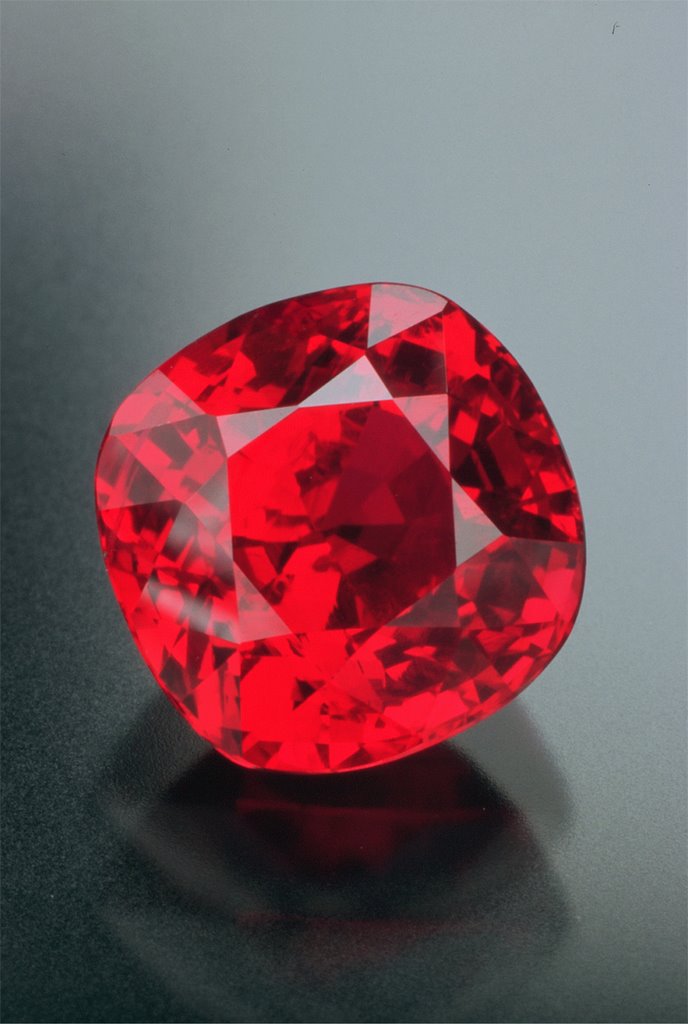
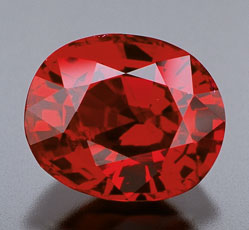
About two months ago I sold an extraordinary 3.30 carat Burma Ruby (pictured) The client, rightly concerned with value, wanted the gem appraised. He asked me if I could recommend and appraiser and aside from the ethical problem of the seller making such a recommendation I had a tough time thinking of anyone other than a wholesale dealer specializing in rubies with experience enough to do it and wholesalers do not know the retail market. To aid the client I obtained an American Gemological Laboratory full quality report. The AGL report graded all aspects of the gem and issued an overall quality grade. I highly recommend this report for important gems. It provides one objective basis to begin the valuing process. (see the report at www.rwwise.com, click gallery, gemstones, ruby)

The client then contacted a professional member of one of the organizations listed above and asked the appraiser for a ballpark estimate and faxed the AGL report to the appraiser. Without ever seeing the gemstone, this appraiser gave the client a “ballpark” price that was so ridiculously low that the client, who had been looking for a ruby for several months realized the price was absurd and decided he needed another appraiser.

How could any professional appraise a gemstone without examining it? You’ve got me! In the case of this so-called professional, he hit a foul ball. Luckily, the client knew more than the appraiser otherwise I might have lost the sale.

The client then asked two well known gemologists, Richard Drucker and Stuart Robertson of Gem World International publisher of The Guide, a wholesale gemstone price guide, to do an appraisal. In a subsequent article in Gem Market News written on appraising this ruby here is what Mssrs. Drucker and Robertson said this stone:


“Pricing this ruby was a challenge…The color was at the top of the spectrum…”

“we looked for comparables…Rubies of this caliber cannot be priced by the cost method and only market data will suffice…”

“…This becomes a gem for the collector’s category and that is an important lesson in pricing. The stone is an example of a gem that grades above The Guide’s extra fine category.”

Gem Market News, Vol. 25, No. 5, September, October 2006, p. 12

Evaluating an ultra-fine gem is difficult because, as Drucker says, you must find comparable stones and if you can’t find comparables you are like a tight rope walker dressed in his underwear balanced on a high wire working without a net. In the end, Drucker & Robertson, after consulting a number of dealers, appraised the stone for substantially more than the client paid and several times the price suggested by Mr.ballpark the professional appraiser.

To sum up, if you want a gem, any gem, appraised. Find a professional with demonstrated familiarity with the gemstone. Check the credentials of local jewelers by checking what they have in their inventory. If they don’t stock the stone, they don’t know the stone. Choose a disinterested professional and pay the price. Don’t expect something for nothing, get a signed document and watch out for foul balls and low inside drives.


Interested in reading more about real life adventures and secrets of the gem trade? Follow me on gem buying adventures in the exotic entrepots of Burma and East Africa. Visit the gem fields of Austrailia and Brazil's famous Capao mine. 120 photographs including some of the world's most famous gems. Consider my book: Secrets Of The Gem Trade, The Connoisseur's Guide To Precious Gemstones.

“Wise is a renowned author... He’s
done a marvelous job of this first book, monumental work, a tour de force...My recommendation: Buy this book”.

Charles Lewton-Brain, Orchid

Only $39.95. You can read a couple of chapters online: www.secretsofthegemtrade.com.

Buy it on Amazon: www.amazon.com


Wednesday, June 28, 2006

Quality, Rarity & Value; Pricing the Crème de la crème of Gems, Part III

By Richard W. Wise, G.G.

© 2006


Lab Games:

Over the past two decades we have seen the proliferation of the gemological laboratory. Ostensibly the function of these labs has been to provide gemological services that require a higher level of expertise and technology than that available to the average jeweler-gemologist and to “certify” the identity, origin and treatments, if any, done to a particular gem.

It is no accident that the growth of the gem labs has coincided with the booming market for colored gemstones. The labs have provided the credibility that has for so long been missing and made this rapid growth possible. The labs are not the only cause; the advent of aggressive marketing spearheaded by the television shopping channels has had a strong impact. We have entered the Age of Information; today education in the form of books, magazines and information provided by the shopping channels themselves has replaced the age old “keep em stupid” strategy that has for so long been favored by the industry.

Cuprite tourmaline from Paraiba, Brazil (see post Pricing the creme Part II) pretty much had the market to itself until 2001 when Cuprite tourmaline in northwest Nigeria and just lately similar gems in Mozambique. Dealers working with these stones naturally wanted to cash in on the Brazilian gem’s market cache and call these gems Paraiba. This has sparked a lot of controversy in the gem trade and promises to create a lot of confusion among collectors. In February 2006 the Gemstone Industry Laboratory Conference (GILC), a committee made up of representatives of most of the leading labs met and decided that they would use the term Paraiba to describe this variety of tourmaline regardless of its source.

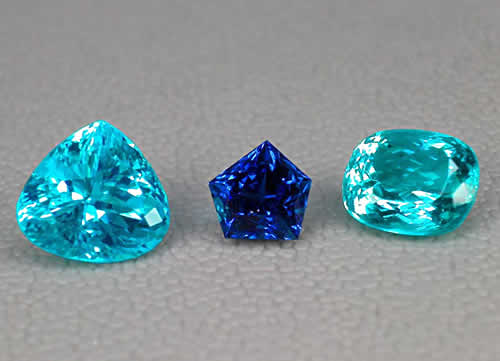
Image: Paraiba tourmalines; origin: Brazil. The pear shaped gem (left) is the highly desirable Carribean Blue (image courtesy Pala International)

The standard scientifically accepted nomenclature for describing a gem is to use the species name followed by the variety and finally origin, for example, species: Corundum, variety: ruby, origin: Burma. Until just recently this standard had been applied universally by gemological laboratories. The GILC’s action effectively turned the standard terminology on its head. Thus, it is now possible to encounter certificates with language such as: species: Elbaite tourmaline, variety: Paraiba, origin: West Africa, the proper variety name, Cuprite, is simply ignored.

It is important to recognize that although the public is wisely demanding written assurances from gemological laboratories of type, treatment and origin of gemstones prior to purchase, these certificates, grading reports or whatever euphemism is used to describe them, come from dealers and it is the dealers and jewelers who purchase the reports and are, therefore the laboratory’s best customers. Laboratory reports have become defacto sales documents and labs are under pressure from the dealers to put the best spin on things. Just as the public has begun to trust the labs to "certify" and thus guarantee that a stone is what the seller says it is, the labs have begun to betray that trust.

Reductio ad absurdum; geography versus beauty:

Unfortunately uniformed buyers have reduced the appreciation of the qualities described earlier (see posts Pricing the Crème Part I & II) to the absurd pursuit of any gem with a desirable geographic pedigree. Kashmir gems without the fine color and lacking the misty quality, emeralds that look like broken coke bottles and Burmese aquarium gravel will command a premium price in the market simply because the have an origin certificate from a recognized gem lab and despite the fact that they lack the very qualities that made these gems great.

This absurdity is the result of a very common market assumption that involves the logical fallacy of assuming the inverse. The proposition: All gem dealers are idiots may or may not be true but assuming the inverse: All idiots are gem dealers is both logically invalid and demonstrably false. Each of us knows at least one or two idiots who are not gem dealers. Likewise the proposition: All the finest rubies are from Burma may also be true but the inverse: All Burmese rubies are fine is also invalid and demonstrably false.

Gems are all about beauty. They have no nutritional value; they won’t keep the rain off or warm you in winter. What does it matter where a gem was found so long as it is beautiful? The fact is there are some very fine rubies found in other geographic areas and some really poor quality found in Burma. In the final analysis it matters little weather the stone was found in Burma or New Jersey.


The problem is, the market subscribes to this fallacy and geographic pedigree does affect price. Returning to cuprite tourmaline, the Paraiba designation does carry a market premium. The action taken by the labs sacrifices consistency for the sake of marketing and can do nothing but sow confusion and foster distrust among consumers.

This just in….

I am hearing a new rumor. According to sometimes reliable sources, the American Gem Trade Association (AGTA) Board of Governors has voted to reverse the decision made by its lab representatives at the GILC meeting in February. Stay tuned…

Richard W. Wise is a goldsmith and gemologist and is president of R. W. Wise, Goldsmiths, Lenox, Ma. Gems & jewelry available at: www.rwwise.com . His critically acclaimed book, now out in paperback can be reviewed at www.secretsofthegemtrade.com.

Saturday, June 24, 2006

Quality, Rarity and Value, Pricing the Crème de la crème of Gems Part II

Quality, Rarity and Value, Pricing the Crème de la crème of Gems Part II

By Richard W. Wise

© 2006

Wildcard Properties:

Some gem varieties also sport particular qualities, what I shall call wildcard properties that affect one or more of The Four Cs of Connoisseurship (color, cut clarity, crystal) and will dramatically effect the price of a gem particularly in the upper reaches of quality. The following is a list of wildcard properties, their affects and effects:

Colorless Diamond; (Crystal): Diamonds reputedly from the old Golconda mines located in northwestern India that exhibit a particularly high degree of transparency. The Golconda fields were the primary source of diamonds from antiquity until approximately 1725 and Golconda stones sometimes come up at auction. Gems with this property are also referred to as super-ds, something of a misnomer because they are really super-transparent and may be found in lower color grades.

Emerald; (Crystal): They are called old mine stones; emeralds mined in the Sixteenth and Seventeenth Centuries at Colombia’s emerald mines as well as particularly fine gems from Pakistan and Afghanistan that leaked into the Indian market during that period.

Oddly enough green sapphire (Oriental Emerald) was so deeply entrenched in the European psyche that the lovely verdant true emeralds of Colombia, stones from mines at Muzo and Chivor that were pried from native hands beginning around 1580, were not well accepted in Europe and were transshipped to India via the Philippines. The Indian Maharajas knew a beautiful stone when they saw one and paid princely sums for Colombian gems.

There is controversy about what constitutes an old mine stone; some experts maintain it is a pure green hue without secondary hues but it is in fact a honey like quality of transparency also called gota de aceite or “drop of oil”.

I had the privilege of comparing several of these old mine gems. This quality can be s

een when comparing a very fine crystalline emerald mined recently with one of these old mine gems. They do indeed exhibit a thick crystalline quality reminiscent of light passing through honey or oil.


Ruby: Mogok Origin: (Color):

“At a carat there is a price. At a carat and one half that price doubles. At two carats the price triples…at six carats there is no price.”

Jean-Baptiste Tavernier, 1688

In 2005 a world record price for ruby was set when a private client from Asia paid the fabulous price of $2.2 million or $274,6

56 per carat for an 8.01 carat oval ge

m. This bested the previous record of $228,252/ct. set back in 1988 with a 15.97-ct. gemstone. In February 15, 2006 Christies St. Moritz shattered that record selling a 8.65 carat cushion shaped ruby to a dealer for the final hammer price of $3.6 million or $425,000 per carat, nearly double the record set just one year before.

What makes Burma ruby so special is a normally invisible quality of ultraviolet fluorescence, rubies from locations in Thailand, which was the ruby standard bearer in the years between the closing of

Burma in 1962 and the discovery of the new Burma ruby deposits at Mong Hsu in the early 90s, have concentrations of iron that quench the gem’s natural fluorescence. In Burma type ruby, found at geologically simila

r locations in Burma (Mogok) (Namya), Vietnam, Pakistan and Afghanistan, some ultraviolet emissions fall into the visible red (at 692.8 and 694.2 nm). The red body color is supercharged by red fluorescence. Vietnamese gems are particularly strong in this quality.

Some dealers are beginning to discriminate between g

ems produced in the Mogok Valley and those from other sources. It is sometimes possible, by inclusion study to separate Mogok stones from other Burma-type rubies from Pakistan, Afghanistan and other parts of Burma (Namya and Mong Hsu). Taking the cue from Emerald, ruby from the original source are referred to as old mine.

Blue Sapphire; (Crystal): Kashmir stones, those mined on one side of a rocky hillock in the Indian State of Kashmir f

amed for their fine color and the quality of transparency or crystal, that is variously described as a velvety, milky, misty, fuzzy glow. This affect is the result of light passing through myriads of extremely small inclusions called, variously flour, sugar or snow. Like the Starship Enterprise passing through an asteroid belt, light colliding with these tiny particles results in the signature fuzziness in the Kashmir gems. Kashmir sapphire from the original deposit was essentially mined out in the 30s and though some continues to dribble out from adjacent areas, they rarely show the quality of gems from the original mine.

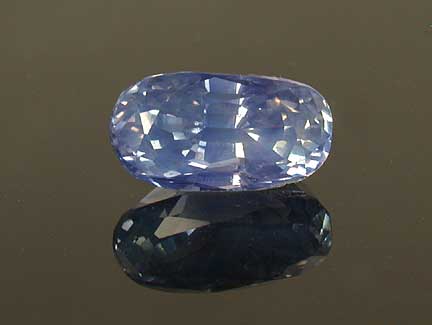
The image (left) shows a Kashmir sapphire of indifferent color with a very distinctive velvety glow: The affect is often difficult to capture in an image. The image (below left) shows a Kasmir sapphire in its full glory, fine color and glow. (image courtesy Pala International)


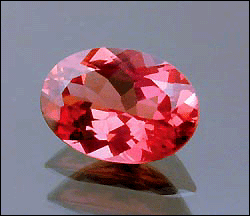
Padparadscha Sapphire; (Color; saturation/Crystal): Speaking of padparadscha (see Grading the creme, Part I); though some experts insist upon Sri Lankan (Ceylon) origin, geography (gratefully) plays almost no role in pricing. Padparadscha is all about color. Which hue should dominate and what are the preferred mixtures of pink and orange? This remains undefined. However, it is safe to say that a true padparadscha has significant percentages of each hue. Although labs are now calling gems with even a trace of one or the other, orange

stones with less than 20% pink and pink stones without similar percentage of orange secondary hue should not be considered. The gem pictured ( right) is a padparadscha sapphire from Malawi, West Africa.

Some padparadscha’s will exhibit a strong orangy fluorescence under ultraviolet. Like the rubies of Burma, this quality tends to supercharge and sometimes overcharge the

saturation of color in the gem. To much fluorescence may overcharge, that is, reduce the transparency or crystal of the gem. Moderate orange fluorescence can be a plus though one not truly recognized or quantified by the market.

Paraiba Tourmaline (Color; saturation)

In the late 1980s a new type of tourmaline was found in the Brazilian state of Paraiba hard up against the border of Rio Grande do Sul. These unusual tourmalines had trace elements of copper that endowed the best of these gems with an intense neon-like saturation. What we call color is scientifically divided into three components hue, saturation and tone, hue is the term for color as we normally use that term and saturation refers to the brightness or intensity of the hue. (see Secrets Of The Gem Trade Chapter 2) International orange is an example of a particularly saturated hue.

The best of these copper colored beauties are a medium toned Caribbean Blue, a visually pure highly saturated blue similar to the color of the shallow waters of the Caribbean Sea that is considered the finest color in this gem. The gems of Paraiba became the gemstone success story of the Twentieth Century as the prices for these stones escalated from a few hundred dollars a carat into the tens of thousands.

Cupriian tourmaline from Paraiba pretty much had the market to itself until 2001 when Cuprite tourmaline in northwest Nigeria and just lately similar gems in Mozambique. Dealers working with these stones naturally wanted to cash in on the Brazilian gem’s market cache and call these gems Paraiba. This has sparked a lot of controversy in the gem trade. In February 2006 the Gemstone Industry Laboratory Conference (GILC), a committee made up of representatives of most of the leading labs met and decided that they would use the term Paraiba to describe this variety of tourmaline regardless of its source.


To be continued...


Interested in reading more about real life adventures in the gem trade? Follow me on gem buying adventures in the exotic entrepots of Burma and East Africa. Visit the gem fields of Austrailia and Brazil. 120 photographs including some of the world's most famous gems. Consider my book: Secrets Of The Gem Trade, The Connoisseur's Guide To Precious Gemstones. Now only $39.95. You can read a couple of chapters and order online: www.secretsofthegemtrade.com.

Buy it on Amazon: www.amazon.com


Saturday, June 17, 2006

Quality, Rarity & Value; Pricing the Crème de la crème of Gems.


Quality, Rarity and Value, Pricing the Crème de la crème of Gems Part I.

By Richard W. Wise, G.G.

At Christies April 2006 Magnificent Jewels auction a pear shaped D IF diamond weighing 50.53 carats sold for 4.2 million (83,450 per carat), another D-color pear shape stone weighing 50.67 carats sold at the same auction for 2.6 million. The difference: two clarity grades, the second diamond was a GIA certed VVS2. The vast difference in the two prices brings into sharp focus the role of rarity in the pricing of a fine gemstone. I choose this example because the GIA grading system is precise and universally accepted. If there can be such a dramatic difference in value between two visually identical colorless diamonds consider the difficulty in pricing colored gemstones which are not so similar and for which no universally recognized system of grading exists. Lets take the worse case, consider the padparadscha sapphire. A moment to define our terms; we are talking about a natural untreated g em. On June 7, 1995 Christies sold a magnificent 20.84 ct. padparadscha sapphire at $374,400 ($18,000 per carat).

What the heck is a padparadscha sapphire anyway?

Unlike ruby and blue sapphire, padparadscha cannot be separated from other varieties of corundum by chemical analysis or any other scientific test. Padparadscha is not a type or variety of sapphire, it is simply a color. So, what color is it? Most experts, at least those in the U. S. subscribe to Robert Crowningshield’s definition stated in an article published in Gems & Gemology Magazine in 1982:


“…this color range should be limited to light to medium tones of pinkish orange to orange-pink hues…”

This seems clear enough but consider the following:

“Lacking delicacy. (emphasis mine)The dark brownish-orange or even medium brownish-orange tones of corundum from East-Africa would not qualify under this definition. Deep orangy red sapphires likewise would not qualify as fitting this definition.”


How do you define delicacy in a gem lab? Ok, so delicacy in this context refers to “light to medium tone” as opposed to a dark robust tone, certainly definable even quantifiable.

but here comes the really difficult part. The definition of hue, pinkish-orange to orangy-pink, presents an almost infinite range of hues. Given the grading tolerances, one D color is pretty much like another, whereas two padparadscha sapphires can be worlds apart. How is it possible to develop comparables on gems with such a broad range of possible hues? And, what constitutes the most desirable and therefore most valuable hue? Is it a pink stone with an orange secondary or an orange stone with pink?

Working Without a Net:

Whether its a connoisseur, a serious collector or just a fussy consumer who desires the finest of the fine, will find himself working without a net. As you climb higher rarity assumes a greater role and as you approach the pinnacle smaller nuances in the four Cs of Connoisseurship; (color, cut clarity and crystal) that I define in detail in my book Secrets Of The Gem Trade, The Connoisseurs Guide To Precious Gemstones, make for broader variations in price.