By Richard W. Wise, G.G.
©2006
A recent fi nd of cuprian(copper colored) tourmaline from Mozambique is making a lot of waves among gemstone dealers and collectors..
Reportedly these gems come from an alluvial deposit near Mozambique's Alto Ligonha. Region. One source tells me that the water born material is essentially mined out a statement that should always be viewed skeptically. The source of these river pebbles is yet to be found. This same source suggests that the entire production may be less than 50 kilograms of rough stones.
Is Mozambique the new Paraiba?
Much of the material cuts eye clean gems. Unlike the original material from the now famous São José da Batalha mine in the Brazilian state of Paraiba and two similar Brazilian locations which yielded mostly visually included smaller gems, the Mozambique cuprian is larger and a number of eye-clean 20-60 carat stones have been cut.
The color is said to be a more uniformly "aquamarine blue" than gems from the Brazilian find which featured a color range of green, blue-ish-green to blue. The blue color, usually described as Caribbean or Windex blue is dominant and the hue is described as "watery" meaning that the gems lack the supercharged saturation of the finest Paraiba stones. This is particularly true in cut gems in smaller sizes (under 5 carats). Larger size gems seem to hold the color better and appear to have saturation closer to their Brazilian counterparts. I have not seen enough of the stones to make a definitive statement but what I have seen is quite beautiful though paler in saturation than the best of Brazil. One dealer suggested to me that the blue-green material was far more beautiful.
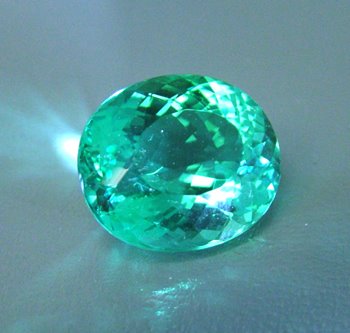
Image: Looking pretty super, this 13.42 carat oval is a highly saturated light-medium tone green-blue hue from Mozambique
Prices:
Partisans of the new material from Mozambique are touting it as "Paraiba tourmaline" and asking very aggressive prices. Several sources stated that dealers who are members of the American Gem Trade Association (AGTA) and have purchased significant amounts of rough material pressured the Gem Lab Standards Committee (GILC) for changes in terminology that would annoint these stones "Paraiba" on certificates issued by the AGTA Gem Lab. (see Pricing the crème, Part III). To be fair, CIBJO, the international committee that establishes terminology standards (bet you didn't know there was such a thing) in its 2005 Blue Book has recognized "Paraiba Tourmaline" as an acceptable trade name for cuprian tourmaline regardless of the source.
To Buy or not to buy, that is the dilemma:
The beginning is usually the best time to buy. Why?, because even a small strike can produce an initial flood of gemstones that overwhelms the market causing prices to fall. In a market of limited size such as the colored gem market, the discovery of a new gem variety or a known gem from a new source sparks interest and as interest grows demand increases. At the same time supply declines resulting in increasingly higher prices. We have seen this cycle repeat itself time and time again: Paraiba tourmaline, Spessartite Garnet, Demantoid Garnet are just a few examples of new gem strikes that are going through this sort of market cycle.
However, in the case, Mozambique cuprian tourmaline is being hyped as the "new Paraiba" and asking prices have started out very high despite the fact that the much of the new material does not measure up to the hype. As one source put it, on a scale of 1-10 where the best of the Paraiba Tourmaline would be a 8-10, the Mozambique tourmalines are between 3-6.
With the rise of the shopping channels, gem marketing has entered a new era. During the past decade we have seen a consolidation in an industry previously dominated by wildcatters, small dealers with a limited stake and an even more limited budget. The shopping channels have become economic jugernauts. Selling directly to consumers, with millions in sales and huge numbers of viewers they have begun to control the market. Jewelry Television (ACN) which advertises itself as the world's largest retailer of loose gemstones, grossed over 300 million dollars last year. Witness the recent hype over Andesine (red sunstone) which the shopping channels are also calling “the new Paraiba”. In addition, we see a few big time dealers who watched the Paraiba phenomenon are holding large inventories of Mozambique rough and are determined to pump up the market and cash in big. Today, both these factors are at work and this has resulted in a distorted and overheated market.
My Advice:
If you are going to buy, buy high quality and buy big sizes. Larger stones are reported to "approach" the quality of the original find and if it looks like a duck… Stones from the original Paraiba mines are extremely rare over 5 carats and barely exist over 10. Otherwise, wait for the hype to die down! Market realities will eventually assert themselves and force prices into line with the relative quality of the gem on offer.
P.S. Cuprian vs. cuprite, whats in a name: My readers may have noticed a change in terminology from cuprite to cuprian this is the result of a gentle reminder from one of my faithful readers John S. White former Curator of the Smithsonian Mineral Collection: "Please, enough with this "cuprite tourmaline." Why do you continue to perpetuate what is unarguably the worst name that anyone has applied to Paraiba-like tourmaline? Cuprite is a distinct mineral species, it does not occur within or around gem tourmaline anywhere in the world. Furthermore, making the appellation even more ludicrous, cuprite is red, it is not blue nor green. You would be doing the gem world a favor if you would disavow your usage of this term while perhaps citing several of the others that have a far greater chance of being adopted." Thanks John!



 Posts
Posts