
by Richard W. Wise, G.G.
© 2008
Michael Corneau, our lead goldsmith, is a self taught craftsman. He is fascinated with jewelry, but his academic background is in interior and architectural design. He admires the clean moderne lines of the Constructivist tradition as does Tom Munsteiner.
Sculpture cutting had its beginnings in the late 1930s. Metalsmith Margaret De Patta working under the influence of the Constructivist artist Lazlo Moholy-Nagy in collaboration with San Francisco gem cutter Francis J. Sperisen produced the first gem sculptures. Not much happened after these early efforts until the German lapidary artist Berndt Munsteiner, Tom’s father, began cutting asymmetrical gems from high quality tourmaline and garnet rough. Unlike the earlier work, (labeled Opticuts by De Patta), were designed to create an optical fun house effect, reshaping, distorting and creating a sense of movement. (Pictured below, gold brooch by Margaret De Patta set with a Sperisen double lens cut quartz. The stone was purposely cut as a lens to create a distorted and dynamic image which moves and changes shape as the wearer moves. Photo Courtesy: The Dukoff Collection)
Munsteiner paid more attention to the optical qualities inherent in the gem material itself. He created gem sculptures which were alive with brilliance and scintillation. Tom Munsteiner has followed in his father's footstep though his style tends toward a simplified technical vocabulary that stresses the holographic as opposed to the senior Munsteiner's reliance on visual pyrotechnics.
Mike loved the stone.
"Munsteiner’s work is proud, independent and arrogant", he said.
"Take a shot at a design", I said.
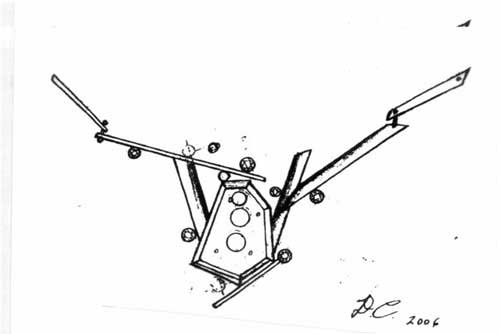
Well Mike kept the stone in his box for a couple of months and one day knocked on my office door with a sketch of a pin/pendant. I thought it was an excellent design that integrated the gemstone into a wearable work of art. Somewhere along the line an accent was need. We went back to the stone box and found a beautiful round red Oregon sunstone that melded perfectly with the citrine and gold.
It is interesting how a design conceived in 2008, inspired and influenced by a gem cut in the Constructivist tradition, can produce a concept for a finished piece that sits four square in the same tradition.
Michael began by making a series of models. This is time consuming, but it is fairly standard practice and it us useful to work out technical details before turning to gold. (Picture: below right, 1st on left: a simple cardboard model of the main shape, the second third and fourth models are made of sterling silver. The last model on the right shows the gemstones set roughly in place.) The chief technical problem involved working out the line of the fold in the metal with the edge of the quartz gem sculpture and working out the position of the accent stone.
 Given the isometric shape of the gem sculpture, this was not easy. The design is subtle and Mike also wanted to get an initial sense of the sort of finish to be used; matte, sanded or perhaps sandblasted.
The Making:
The piece would be hand-fabricated. For those unfamiliar with the method, this is how a true "handmade" piece is actually made. The material is gold sheet, forged, cut and joined. This is quite different from the lost wax process that is used in almost all commercial jewelry. Using wax, It would be impossible to achieve the even lines, crisp edges and sharp angles required and, weight would be a problem in a cast piece.
The hand fabrication begins with rolling gold sheet into the desired thickness and constructing the setting for the stone. The major joining method is soldering. Goldsmiths methods and tools have not changed awfully much over the millenia. Paintings going back 4,000 years, found on the wall of an Egyptian pyramid depict craftsmen using hand tools that can still be found on the goldsmith's workbench.
The laser welder, a tool developed about fifteen years ago, is, perhaps the most important modern edition to the goldsmith's toolbox.
 This is an expensive machine, but it does permit the craftsman to do pinpoint cold-joining as opposed to soldering which is hot-joining. Laser technology is particularly useful when working close to heat sensitive materials like gemstones. (Pictured right: sections of the piece. In the center is the setting for the sculpture, the main shape is to the left. Note the hole. The sunstone will be invisibly "Gypsy set" from underneath so no setting will be
 visible.)
Voila; Finished:

We decided to maximize the versatility of the piece by making it wearable as either a brooch or a pendant. When used as a brooch, the double pin back is very secure. It allows the wearer to place (pin) the brooch at any angle and on thick as well as thinner fabrics, without tearing the fabric. It will also stabilize the piece when it is worn as a pendant. The pendant bail is placed between the double stems. Specifications: Item #9064LPMS 7.5-2.5cm. (2.75"x1"). 18k gold, Citrene 29.73 carats, sunstone 1.10 carats. Price: $8,995.00. For more information: 800.773.0249 (in the U.S.) or email: richard@rwwise.com

Interested in learning more about the connoisseurship of fine gemstones? Read the book that appraisers, dealers and jewelers rely upon. Secrets of The Gem Trade will provide you with the tools you need to understand and appreciate fine gemstones.  Learn the true grading criteria for diamonds, pearls, garnets, ruby, sapphire and opal. All of today's most "precious gemstones".
Read a free chapter online at the Secrets website: or just order it for $35.95 on from Amazon.com
whether you like to know what the best colour is in Tanzanite, or how to grade a Diamond, you will find it in this book. No other book I read before dealt with this topic is such detail as Richard Wise's masterpiece."
A. Van Acker, FGA
Amazon June 2005





 Posts
Posts


