Showing posts with label ruby. Show all posts

Saturday, May 03, 2008

Crisis In Paradise; Pearl Prices in Tailspin

Had an interesting conversation with Josh Humbert, Josh is the proprietor of the Kamoka Pearl Farm in the Tuamotu Islands www.kamokapearls.com , a far-flung windswept archipelago about 300 miles north of the capital island of Tahiti.

Josh’s farm is located on the atoll of Ahe located 350 miles north east of Tahiti in the Tuamotu Islands. Unlike Tahiti, which is a volcanic island, the Tuamotus are true atolls, flat ribbons of coral surrounding a large center lagoon. Conditions in this far off island group are perfect for the culturing of the Pinctada Margaritifera, the parent mollusk of the black pearl.

20% Price Drop in Small Sizes:

According to Josh, all is not well in paradise. Once more, over production has led to a crash in pearl prices at the source and many farms are in financial trouble. You may remember a similar crash in pearl prices about five or six years ago. The last time we were able to offer fine black pearl strands at bargain prices and consumers lapped them up.

Another exceptionally knowledgeable source tells me that the oversupply is mainly in the smaller 8-10mm sizes, pearls in the 11mm+ range are hard to come by and prices are actually higher. At the March GIE auction in Papeete asking prices were high and very little sold. Most lots sold privately, post auction, at prices much lower than the advertised floor prices allowing GIE to claim a successful sale. Pearls in the 8-9 and 9-10mm sizes have dropped approximately 20%.

Don’t expect to see these falling prices right away. Prices at the Las Vegas Gem Shows should reflect the prices on older stock. Unless there is a rebound, these price cuts should trickle down by this fall. Stay tuned...


Book Review

By Richard W. Wise, G.G.

©2008


Gems & Mines of Mogok

by Ted Themelis

Hardcover 352 pages

Self published 2007

For gem enthusiasts, Mogôk is the Holy Grail. This beautiful remote valley together with Afghanistan’s Sar al Sang, is the oldest continuously productive gem district on earth. If there is anything you didn’t know about the gems or geology of Mogôk that was not covered in his previous volume, Ted Themelis’ new book "Gems & Mines of Mogok" has got you covered.

Themelis’ previous book Mogôk, Valley of Rubies and Sapphires published in 2000 focused on the history, people and as the title suggests the fabulous ruby and sapphire produced in the valley. In this new book Themelis turns his attention to the Geology, Mineralogy, Crystallography and mining of the diverse gemstones and minerals found in the Mogok Valley. The book is profusely illustrated with charts and maps of tectonic models and geological models, satellite images together with topographic and geological maps.

Themelis starts right off in Chapter 1 with a comprehensive historical overview of the geology of Mogok replete with a proposed model of the tectonic evolution of the region accompanied by an imposing array of illustrations: a Timetable of Rocks and a two page color Geological map of Mogok, photographs of geological features and rocks divided by type; igneous, pegmatitic, metamorphic. In short, a geologist’s compendium coupled with a rock hound’s field guide to the region.

Most books in this category focus on ruby and sapphire, skipping lightly over the many rare and interesting gems and minerals produced in this complex geological environment. In Chapter 5, Themelis profiles and provides photographs of some sixty gem species and varieties, everything from amblygonite to zircon. In appendix D he provides a handy gemological property chart of the twenty-one most important gemstones complete with refractive index and other key identification criteria. (above right: 8513: 2.09 Natural Mogok Burmese Ruby from the R. W. Wise Collection)

There is something for everyone: For the lab gemologist, photomicrographs of inclusions and descriptions of ruby, sapphire and peridot; for the mineral collector, descriptions and images of a large number of mineral specimens by sub-regions; for the ruby-sapphire aficionado an illustrated discussion of origin determination; for the crystallographer a images and illustrations of crystal habits. Appendices cover treatments of Mogok ruby and sapphire, Burmese gem-jargon, a list of gem mines with latitude-longitude followed by a nine page bibliography.

The book is an awesome, genuine tour de force, buy it! Better still, buy both volumes for $199 and Themelis will throw in a free CD. www.themelis.com . For immediate delivery in the U. S. contact: Mr. Bill Dunn at Hypatiagem@aol.com

Take a boat ride across an exotic lagoon. Visit a black pearl farm and learn how black pearls are farmed and graded.

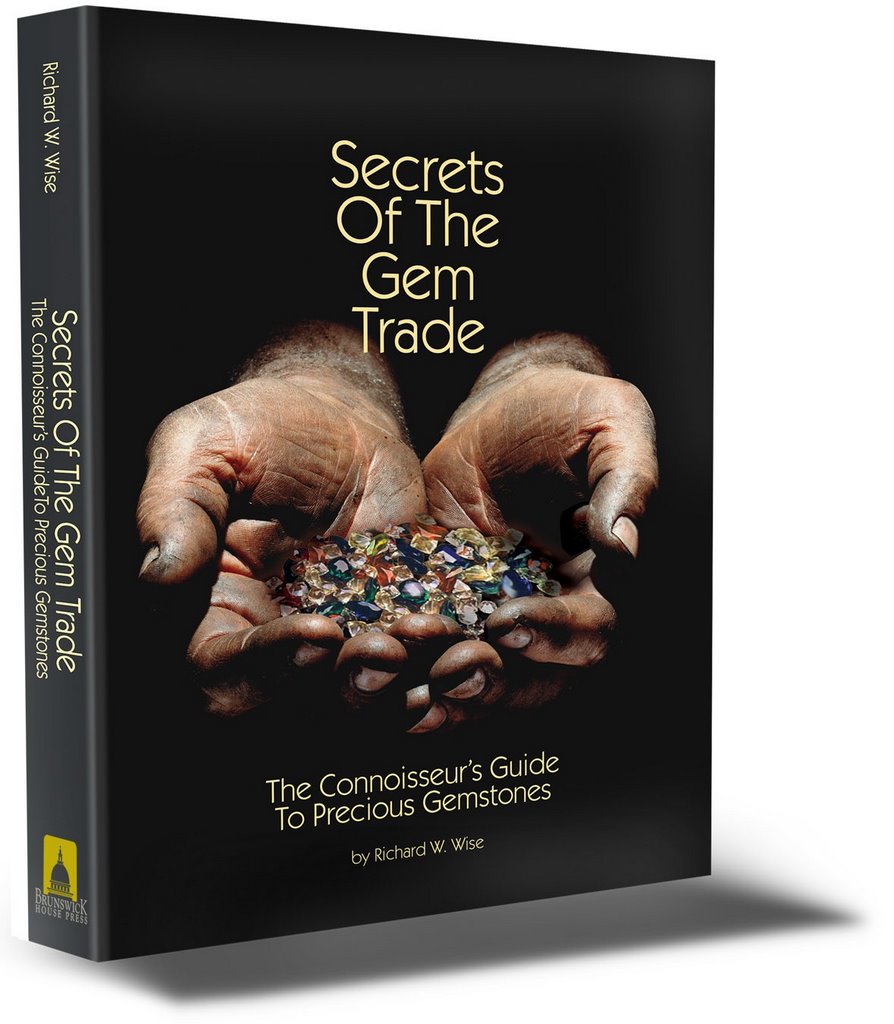
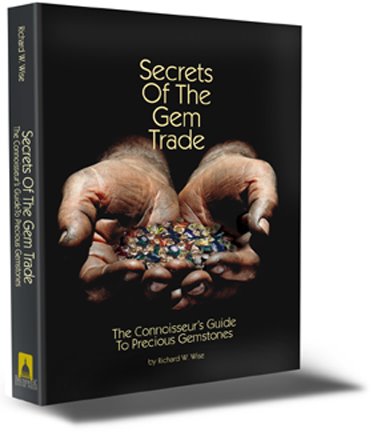
Follow me on gem buying adventures in the pearl farms of Tahiti. Visit the gem fields of Australia and Brazil. 120 carefully selected photographs showing examples of the highest quality gems to educate the eye, including the Rockefeller Sapphire and many more of the world's most famous gems. Consider my book: Secrets Of The Gem Trade, The Connoisseur's Guide To Precious Gemstones.

“Wise is a renowned author... He’s
done a marvelous job of this first book, monumental work, a tour de force...My recommendation: Buy this book”.

Charles Lewton-Brain, Orchid

whether you like to know what the best colour is in Tanzanite, or how to grade a Diamond, you will find it in this book. No other book I read before dealt with this topic is such detail as Richard Wise's masterpiece."

A. Van Acker, FGA
Amazon June 2005

"Secrets Of The Gem Trade: The Connoisseurs Guide To Precious Gemstones by Richard W. Wise is an impressive new reference for dedicated dealers and collectors of gems, gemstones, and ... pearls. Introducing and descriptively exploring each and every gem covered in the easy-to-use reference, Secrets Of The Gem Trade contains an illustrated summary of each stone inclusive of its history and general information, hue and tone, saturation, which may be noticed as the finest, an understanding of the particular gems rarity, and the caution for synthetics and how to depict them, however depending upon the stone there may be description of clarity, color fading, multi-color effect, etc. Secrets Of The Gem Trade is very highly recommended to anyone interested in gemology as a superbly organized, authoritative, comprehensive, and easy-to-follow reference."

Midwest Book Review
April 2006

Only $35.95. Read a couple of chapters online: www.secretsofthegemtrade.com.

Buy it on Amazon: www.amazon.com


Friday, November 23, 2007

"Asking to see the Pigeon's blood is like asking to see the face of God"


About once a month on one of the gem forums someone asks the question:

"What color is pigeon's blood."

by Richard W. Wise, G.G.

©2007

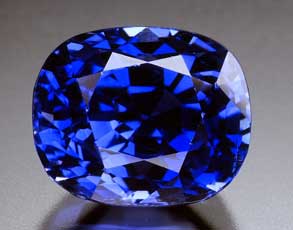
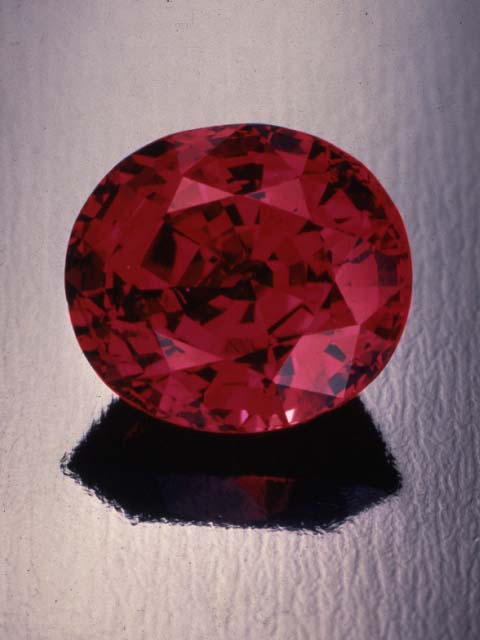
The real question is, of course, "what is the best color in ruby." Although I cover the question in some depth in my book; Secrets of The Gem Trade, The Connoisseur's Guide to Precious Gemstones, it appears that a few people have yet to read the book. (pictured above a gem quality 2.09 carat natural old mine Burma ruby with a GRS "pigeon's blood certificate)

The short answer is simply that rubies should be red. Problem is there are almost no visually pure color in nature so, we speak of a mixture of colors. In gems, we normally speak of a primary and a secondary color or hue. Gems may have more than two hues but it it is difficult for even the most discerning connoisseur to see more than two. Still a ruby must be predominantly red, that is, have a primary red hue. Put another way in the color mix, red must be at least 51% of the hue mixture. If its not red its not a ruby. Any member of the gem family corundum that is any color other than red we call sapphire.

Ruby may exhibit one of a few possible secondary hues. These are: pink, purple and orange. Purple and orange are the hues immediately adjacent to red on the color wheel. You will never find a ruby with a green secondary hue. Pink, a paler less saturated red is also possible. The finest color or pigeon's blood exhibits a purple secondary hue. Why purple, there are two good reasons; one historical and the other based upon color science.

This historical explanation I owe to Vincent Pardieu. Vincent began by studying gemology in Burma and he found a dealer who explained "pigeon blood" to him. The Burmese coined the term. Purple is a hue that falls between blue and red on the color wheel. It is known scientifically as a modified spectral hue.
The Burmese set gems in pure gold which is a a very rich yellow color. Blue is the compliment of red. Complimentary colors are those that cancel each other out. So when a purplish red ruby is set in yellow, the yellow of the metal cancels out the blue in the purple leaving behind, guess what an almost visually pure red.(pictured above a 1.63 carat gem quality old mine Burma ruby with a GRS "pigeon's blood certificate). So the goal for the Burmese is red, pure red! See more!

I wrote my book several years before I met Vincent in Bangkok. However, I reached the same conclusion by applying a logical analysis. My reasoning goes something like this. Color Science teaches that the color red reaches its optimum saturation (brightness) at a fairly dark tone, somewhere about 80%. This is not opinion, it is measurable scientific fact.
If you consider that 100% tone would be pure black, 80% is pretty dark. Pink and orange on the other hand reach their optimum saturation at fairly light tones. Pink obviously as it is by definition paler (less bright). Orange reaches its optimum saturation at between 30-40% tone.

Purple reaches its optimum saturation at around 60% tone. Now, if you add a light pigment to a dark paint you would obviously lighten the overall effect. Same is true in transparent media. The optimum tones of red and purple mix fairly well both being both dark in tone. The purple unlike the pink does not dilute the red. Pink and orange would lighten the red thus reducing the overall saturation of the pinkish-red or orangy-red color. Purple reinforces the red, orange and pink dilute. Make sense? Not everyone agrees. Some connoisseurs like a bit or orange. They feel it frames and pumps up the red hue. A good point if you consider the effect of orange in red spinel. Be that as it may, for good historical as well as scientifically verifiable reasons, orangy red is not pigeon's blood.

The first image above is of a 2.09 carat Burmese natural ruby from the old min at Mogok. This stone has a bit purer red, exhibits less purple than the second stone, a 1.63 carat gem from the same mining area. Both, however, have been grading "Pigeon's blood" by GRS, Swiss Lab, Bangkok. As you might imagine this lab sees an awful lot of rubies. Both stones are from the Mogok Valley, this is the place, going back to the Bronze Age, where the original stones were mined back when the term pigeon's blood was coined. A lot of the gems currently in the market are from a new mining areas Mong Hsu that is about half way between Mogok and the Thai border. Mong Hsu stones can certainly be pigeon's blood color but since we are talking about a historical term I thought it best to use illustrations from the old mine.

By the way if you are looking for the ultimate Christmas present, both these gems are available for sale.


Want to Learn more?

Follow me on gem buying adventures to the old Burma ruby mine at Mogok. Learn how to judge the quality of rubies, sapphires, emeralds, garnets and 31 other gems. 120 carefully selected photographs showing examples of the highest quality gems to educate the eye, including the Rockefeller Sapphire and many more of the world's most famous gems. Consider my book: Secrets Of The Gem Trade, The Connoisseur's Guide To Precious Gemstones.


“Wise is a renowned author... He’s
done a marvelous job of this first book, monumental work, a tour de force...My recommendation: Buy this book”.

Charles Lewton-Brain, Orchid

whether you like to know what the best colour is in Tanzanite, or how to grade a Diamond, you will find it in this book. No other book I read before dealt with this topic is such detail as Richard Wise's masterpiece."

A. Van Acker, FGA
Amazon June 2005

"Secrets Of The Gem Trade: The Connoisseurs Guide To Precious Gemstones by Richard W. Wise is an impressive new reference for dedicated dealers and collectors of gems, gemstones, and ... pearls. Introducing and descriptively exploring each and every gem covered in the easy-to-use reference, Secrets Of The Gem Trade contains an illustrated summary of each stone inclusive of its history and general information, hue and tone, saturation, which may be noticed as the finest, an understanding of the particular gems rarity, and the caution for synthetics and how to depict them, however depending upon the stone there may be description of clarity, color fading, multi-color effect, etc. Secrets Of The Gem Trade is very highly recommended to anyone interested in gemology as a superbly organized, authoritative, comprehensive, and easy-to-follow reference."

Midwest Book Review
April 2006

Now 20% off. Read a couple of chapters online or buy one of the few remaining limited editons: www.secretsofthegemtrade.com.

Buy it on Amazon: www.amazon.com

Labels: , , , , ,


Thursday, May 17, 2007

Kashmir Sapphire Sets Record; A Victory for Style Over Substance?


A Victory of style over Substance?

April 25th at Christies, in a packed auction gallery, lot 261 a cushion cut 22.66 carat Kashmir sapphire set in a pendant surrounded by diamonds sold for a world record price of $3,064,000 to an anonymous bidder. At $135,000 per carat, this sale topped the former world record held by the 66.02 carat “Rockefeller Sapphire” a Burmese gem that sold for $48,871 at auction in 1991. This sale marks the ascension of sapphires found on a rocky hillside in the Indian State of Kashmir into the pantheon of super-star gemstones.

Speaking in the wake of the sale, Christie’s Head of Jewelry, Rahul Kadakia, made the following rather curious statement:

“This auction marks a turning point in the jewelry world where original design, rarity and provenance prove to be just as important as the quality of a gem.”

What precisely did Mr. Kadakia mean? Is he celebrating the final triumph of style over substance? Does he mean that the sapphire in question though rare is not so fine? The record breaking sapphire pendant (above) is certainly not a striking example of original design.

According to Christopher Smith, Vice President & Chief Gemologist at The American Gemological Laboratory, the sapphire in question is a “nice stone”. Smith, who has seen the stone but under less than ideal circumstances, makes the point that sapphires of the finest color tend to be a bit dark particularly in subdued lighting. This stone is a bit lighter and brighter at about 70% tone on the AGL scale where 80% would be ideal. The stone is well proportioned, brilliant and on a scale of 1-10 would rate between 8-8.5.

As to the gem’s provenance, interesting though not remarkable, it was never owned by royalty nor lost on the field of battle nor has it had any remarkable stories or curses associated with it. It was purchased by James J. Hill, a Minnesota industrialist of the Gilded Age, and given to his wife, Mary, on Dec. 24, 1886. Originally part of an elaborate necklace—since broken up-- the sapphire remained in the Hill family until the death of Hill’s granddaughter Gertrude Boeckmann Follett, in 2006.

So what business does a nice sapphire like this have claiming a record price? Well though it may not be able to stand toe to toe with the former record holder, the 66 carat Rockefeller Sapphire (image:right), which is in Smith’s words “extraordinary” and one of the “world’s preeminent sapphires”, it is rare. Kashmir sapphires in excess of 20 carats are quite rare and if you own one it’s a seller’s market.

The fact is the finest of the Kashmir sapphire has been recognized as the top of the mark in sapphire almost since the stone’s discovery in the late 19th Century. Celebrated for it’s cornflower blue color and its trademark sleepy quality, a gem with proven Kashmir provenance commands four times the price of a comparable Ceylon stone and twice the price of a comparable Burmese sapphire. Due to its beauty and rarity it was the next logical candidate for gemstone super-stardom.

Is this a “turning point”, a victory of style over substance, of provenance over quality in the gem markets? This much is obvious, just the price of natural Burmese ruby skyrocketed in the wake of the record breaking sale of the 8.01 carat gem at Christies just two years ago, Kashmir prices, already edging toward $100,000 per carat wholesale, will strengthen. Anything with a Kashmir certificate from gem quality to aquarium gravel will see a big boost in asking prices and the publicity will further induce star-struck consumers to choose geography first and quality second. But, this is not a new trend rather just a continuation of a trend that has been in evidence for quite some time.

Follow me on gem buying adventures in the exotic entrepots of Burma and East Africa. Visit the gem fields of Australia and Brazil. 120 carefully selected photographs showing examples of the highest quality gems to educate the eye, including the Rockefeller Sapphire and many more of the world's most famous gems. Consider my book: Secrets Of The Gem Trade, The Connoisseur's Guide To Precious Gemstones.


“Wise is a renowned author... He’s
done a marvelous job of this first book, monumental work, a tour de force...My recommendation: Buy this book”.

Charles Lewton-Brain, Orchid

Only $39.95. Read a couple of chapters online: www.secretsofthegemtrade.com.

Buy it on Amazon: www.amazon.com

Saturday, December 23, 2006

And now a word from our sponsor....


Possibilities for holiday giving

By Richard W. Wise, G.G.

© 2006

The holidays are fast approaching. I thought readers might like to take a look at a something new from our workshop.

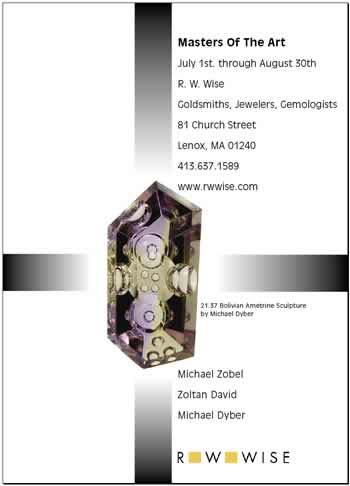
During our summer show, I took the opportunity to select one of the most interesting of the Michael Dyber gem sculptures to make into a necklace and turned it over to Douglas Canivet. The center stone pictured is a 42.25 carat ametrene. This gem material shows both yellow and purple in the same crystal. It comes from only one mine, Anahi in Boliva. I like the combination of zoning and rich color and the sensitive way Michael integrated the natural features of the gem into a pleasing composition.

The necklace was completely hand fabricated. For those of you who don’t know, hand fabrication is the old method of hand making. We use the same methods as those pictured on the tombs of Egypt’s famous Valley of the Kings. In this case all the pieces were cut out of sheet gold. I don’t like to use the term handmade because everyone, including a lot of stuff that is mass-produced, is called “handmade.”

Construction and Materials:

The construction, exclusive of design time, took more than sixty hours, that’s a week and a half for a master craftsman of Doug’s caliber. We used 35.3 penny-weight (dwt.) of 18k gold. Penny weight is an old unit of measure, 20 dwt. to the ounce so a bit over an ounce and a half. The eight diamonds; 1.08 carat total weight of D-E, VS color ideal cut stones set in handmade tubes. Ideal cuts are perfectly proportioned stones that deliver between 92-98% total light return. They are dazzlers!

Notice the joinery, how the angles at which the gold links join create a juxtaposition of shape and plane that compliment the center sculpture. Note how the diamonds appear to float. The gold has a sandblasted finish. This allows the gems visual room to work.

Craftsmanship:

Contemporary hand fabricated jewels look simple. Because the designs are clean without excessive ornamentation you get the idea that they are simpler to make than say Victorian pieces with all the filagree. Not true! Most handmade jewelry is put together with gold solder and gold solder will not "fill in" empty space so every join must be fitted perfectly. Fine cabinetry is a good analogy. Its very much like building a desk or cabinet. Every angle requires a solder joint. It took about eight separate pieces just to make the setting for the center stone. In this necklace everywhere you see an angle there is a join and if the fit is not perfect you will see lumps, holes and porosity at the joint. In such a "simple" design there is no where to hide your mistakes. A master's hand is evident not only in what you see but also in what you don't see.

Handmade is better made:

Is there a difference between hand made and mass-manufactured. Most mass-manufactured jewelry is designed by people who have never worked in gold. The design is drawn or created on a computer then mastered in wax. The element of dialogue, the give and take between the artist and his materials together with the fine eye and sensitive mark of the hand is always missing. Then, of course, it is the only one! Does uniqueness have value? Today, much custom design is done with CAD software. A craftsman can tell a CAD designed piece a mile away. It is yet another step removed from the hand. To me CAD designed jewelry has a sterile soul-less quality.

Other Possibilities:

May I show you some of the newest additions to my gem collection? These are stones sourced on my recent trip to The Orient. These are one of a kind gems that to my eye are extraordinary.

Padparadscha Sapphire:

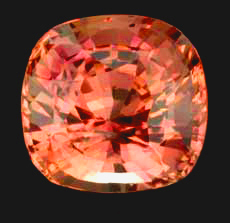
There seems to be a lot of interest in Padparadscha sapphire. As I define it in my book; Secrets Of The Gem Trade, Padparadscha, the word is a corruption of the Singhalese padma raga or “color of the Lotus”. Padparadscha is a pinkish orange to orangey pink sapphire. Here is the important point it must be a delicate hue. The Sri Lankans prefer as stone with a bit more pink than orange. This stone embodies the essence of the term. It is a 3.98 carat natural stone with no enhancement or treatment of any kind. It is has a flower-petal soft quality.

True un-monkeyed-around-with padparadscha sapphires is one of nature’s great rarities. This is one of the finest stones I have seen in my career. The shape makes it an excellent candidate for a pendant but if you will accept my advice, make a ring. Rings are for people who love gems and want to stop and admire.

Purple Mozambique Tourmaline:

Rare and beautiful, until the new find of cuprian tourmaline from Mozambique, I had never seen a purple tourmaline. Most purple tourmaline is actually purplish red. I am told that true purples have been found in the past few years but they were almost always heated to turn them the more desired electric blue.

I am told that the stones from Mozambique are of two types; those that can be successfully heated and those that cannot.

This one is a visually pure purple. It weighs 8.14 carats. In the magnified image you can see straight growth tubes but without magnification the stone is eye-flawless viewed face-up. It is a visually pure purple with no evidence of gray and it stands up well in both natural and incandescent lighting.

Fancy Color Diamonds; A Sweet Suite:

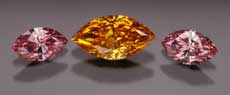
I tried to resist this delectable suite of orange and purple fancy color diamonds but I failed. The language of the GIA certificate calls the center a “Yellow-Orange” meaning that the two hues exist in fairly equal proportions. To me it is a yellowish-Orange, a true tangerine with all the warmth and richness of the sun kissed fruit. The two vivid purple-pinks are pure of hue with no gray or brown to either dull or muddy the hue. All three understated, elegant and beautifully cut.

A Burma Gem:


This ruby is a 2.05 carat emerald cut gem. What is a “gem”. In the gem trade, this is the appellation reserved for the crème de la crème, the finest of the fine. Everything, color, cut, clarity and crystal must be outstanding for the gem type and here it is.

“Asking to see the pigeon’s blood is like asking to see the face of God.”

Anonymous Burmese Trader

Love that quote but the truth is not quite so mysterious. “Pigeon’s blood” is a pure medium dark red with a touch (10-15%) blue that when mixed with the red reads as purplish. As an old Burmese jeweler explained it; the blue is cancelled out its compliment, the rich yellow of high carat gold leaving the gem a visually pure scarlet when set.

We have a number of fine rubies as well as fine handmade originals, antique jewelry and gemstones pictured on our website: www.rwwise.com . Please take a look and if you see something you like call me at 800.773.0249 or 413.637.1589 if you live in Berkshire County.

Looking for a large stocking stuffer? Consider Secrets Of The Gem Trade, The Connoisseur’s Guide To Precious Gemstones. Now in PAPERBACK for only $26.95 at our website or slightly higher at Amazon.com www.secretsofthegemtrade.com.
“Wise is a renowned author... He’s
done a marvelous job of this first book,
a monumental work, a tour de force...

My recommendation: Buy this book”

Charles Lewton-Brain, Orchid


Sunday, August 13, 2006

Burma Journal: On The Road To Mandalay, Part III


By Richard W. Wise, G.G.

©2006

"Oh the road to Mandalay where the flying-fishes play, An the dawn comes up like thuner outer China 'crost the bay"
Rudyard Kipling


Day Three:

It is the beginning of the summer season. The days are hot but the nights turn cool in the hours past midnight. I fall asleep early and wake up in the predawn darkness. I am sitting on my verandah typing away, enjoying the cool morning breeze blowing off the river. My little cottage overlooks the Irrawady. An early rising cock crows nearby. Ghostly lights far off on the opposite bank of the river flicker through the mist and the thumping sound of a one lung diesel powered fishing boat echoes off the river.

Today we go to Mandalay. There is no hurry and we leave late morning. I take a swim while Lwin locates more fuel then we are off. My guide is in top form. Houses, cars, buses, bicycles and trishaws whiz by like the chase scene in a silent movie. Charlie Chaplin on wheels! Here and there we stop, I shoot a few frames and off we go. Actually Lwin is quite willing to stop but it is often difficult to see an interesting shot as it is usually behind us by the time I make a decision to shoot it. Just the same I am seeing the real Burma.

Five hundred thirty miles in three days! Traveling six hours a day that means our average speed works out to just twenty-nine miles per hour. To me it feels like doing eighty in a fifty mile per hour zone. The average speed of automobile travel in the U. S. is perhaps forty five miles per hour. The average here in Burma is closer to fifteen. In a world that moves at one third the speed I am used to, doing thirty seems like flying. Still, six hours spent jouncing along old dirt roads, sometimes with sand just clearing the hubcaps in an automobile with fourteen-year-old springs, takes its toll. We revisit the idea leaving the car in Mandalay and taking the Sunday night flight back to Rangoon. This is an idea whose time has definitely come.

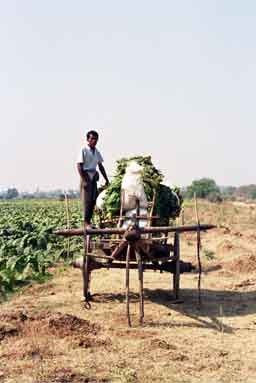
The sky is dark blue and cloudless. Not a hint of rain in the air. The landscape continues to be arid. We pass a series of irrigated fields. They are growing tobacco. The peasants use bullocks to plow up the dark mud. In one field the tobacco leaves are spread out drying in the tropical sun. The road alternates between tarmac and long stretches of dirt road. “This is the good road” Lwin tells me. Good?, I’d hate to see the bad but just then we reach it. The road will lead us to the main artery that runs between Rangoon and Mandalay. Finally we reach it. It is indeed nicely paved and would you believe, four lanes. Traffic is sparse. “This is more like it”, says Lwin, “now we can do one hundred forty km.” We pass an American style toll both with about eight lanes, a gate and a little metal booth at each one but the toll booths are empty, the little booths sit lonely in the sun. No doubt built with foreign aid. We just maneuver around it and continue on our way.

Life Along the side of the highway is little different from that along the secondary roads we have been traveling . No mega gas stations, no fast food malls. The closer we get to larger population centers the more trucks and motorbikes we see. Along the country roads, the people were almost always on bicycles and trishaws. Goods and people move by human muscle power.

We arrive in Mandalay at about One o’clock. Mandalay is a large city with broad streets and avenues. The streets are well kept and have names like "66th".

We stop at Lwin’s favorite restaurant. I know the drill: pick and pick out my dishes at a glass walled counter. They are brought to our table along with a steaming mound of fluffy white rice. We order fresh squeezed lemonade from a stall just outside. I decide on mutton balls, Lwin orders fish. Each is served with several dishes of condiments, tomato, chili, bean dip and a plate of raw vegetables. I pick up a long green pealed vegtable that . looks like a kind of squash and tastes like it too. Lwin offers me a slice of peeled green mango; the taste is very much like lemon.

Mango is a favorite of mine. The rich creamy fruit was just coming into season in Thailand when I arrived. I enjoyed several during my stay in Bangkok. Unfortunately mango is out of season in Burma.

Soup is always part of the meal. It bubbles away in a huge iron cauldron. I am not sure what the soup base is but kale is a major ingrediant.

Cheap nourishing soups are a staple in Asia. Bowls of hot, tasty soup can be purchased at tiny wooden wagons in Thailand, Soba houses in Japan, and funky open fronted restaurants in rural Burmese towns. The smell of boiling stock fills the air on early morning walks along the klongs and back alleys of Bangkok. A version of it has been on our table at each meal. It is hot and tangy and is slurped along as part of the main meal. If you can’t afford anything else you can always live on soup.


Tomorrow, Lwin promises, several of his miner friends will make the trip down from Mogok to show us stones. Stay tuned...


Want more? Read on: www.secretsofthegemtrade.com
Free sample chapters then buy the book!


Thursday, August 03, 2006

Burma Journal; On The Road To Mandalay, Part II

By Richard W. Wise, G.G.

©2006

Day Two:

After a good night’s sleep we are up and on the road early. The morning is cool, the air sweet like early New England summer, the heat doesn’t become oppressive until about noon. Until then we tool along with our windows rolled down, saving our air conditioning and fuel. I am feeling good and ready to take photographs so we stop several times along the road.

In one small town, Lwin pulls over. There is a wedding in progress and he stops for me to take few shots. I am immediately accosted by one of the guests who insists that I come in and take a picture of the bride and groom. The music stops, I am shown a seat. Tea, cakes and a pack of cigarettes appear on the table before me. I am embarrassed, upstaging the young couple on this their most important day. They seem bemused and not at all pleased. They are young, perhaps fourteen, and sit solemnly on a small raised stage in the front of the hall, he in a white suit, she in a wedding dress. So I smile, take a few photographs, bob my head up and down, mouth inanities, thank the guests and back the hell out of there.

The landscape becomes increasingly arid as we move along the second leg of our journey. The tarmac ends and we are on a narrow sandy dirt road. It looks like drought.

The fields are dusty and flat and the clipped dry grass rolls out toward the horizon in all directions. The trees are devoid of leaves with knarled brown fingers clutching at the sky. Even the peasants working their fields have changed their color from dark copper to light mocha brown. They are preparing their fields but planting must wait for the rainy season that is nearly six months away. We stop for lunch in a restaurant in a small rural town called Kwajo.

Our second night finds us camped out in a small hotel on the banks of the Irrawady River. It’s called the Bagan Thande. Fifty-two bucks a night payable in U. S. Dollars of course. Lwin gets off much cheaper paying about fifteen dollars in the local currency. Foreigners in Burma are officially required to pay for hotels and so forth in dollars and, due to the embargo, no credit cards are accepted.

Much of our second day’s travel his been within site of the river. We can see mist shrouded mountains lining the far bank. The golden dome of a pagoda sparkles in the afternoon sun. Barges and small freighters ply their trade along the river. We have our dinner and breakfast in a garden setting along the riverbank with the welcoming limbs of a giant Acacia spread in a canopy above us.

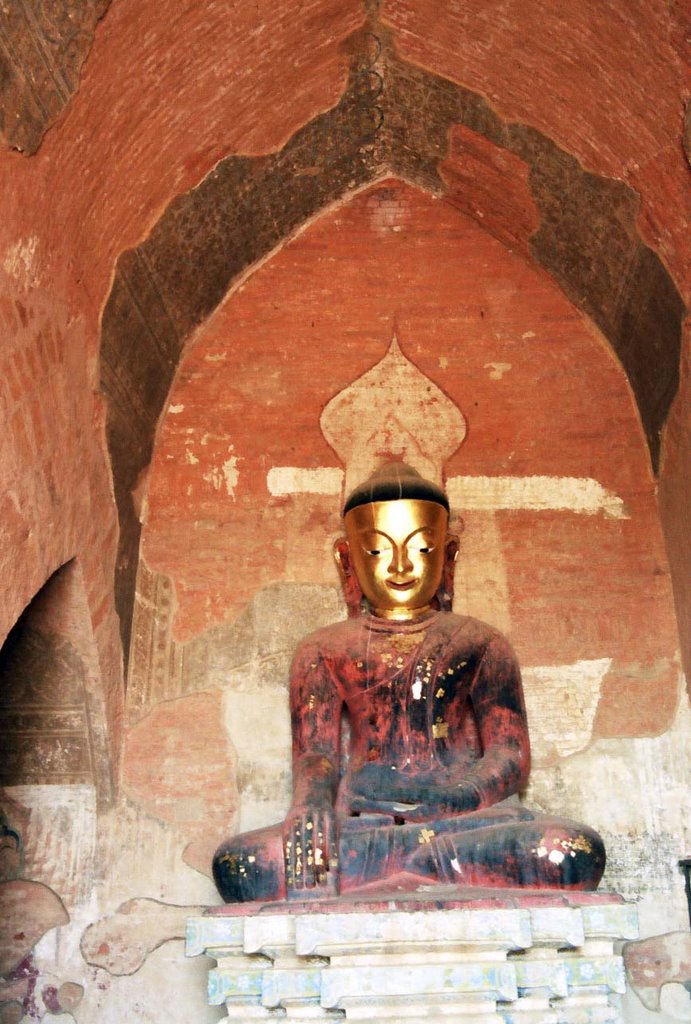
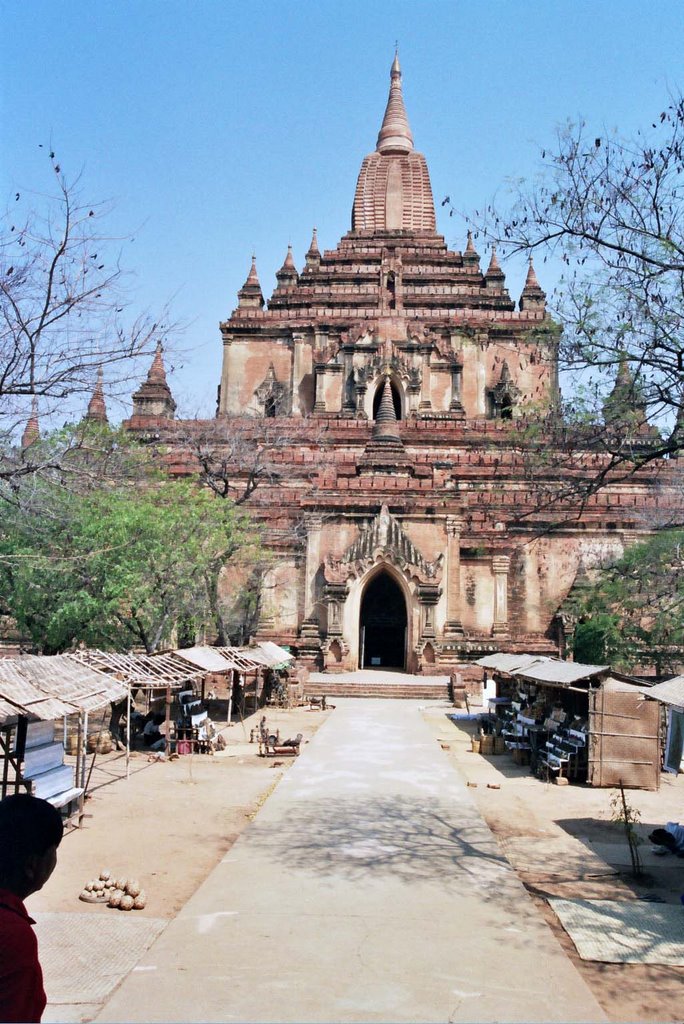
On the way into Bagan we visit our first Pagoda. This one, built in 1183 is, like most, a square layered wedding cake built of red brick with plastered interior walls. The bricks are artfully joined, a testament to the craftsmen who built them. The temple has several giant Buddha statues. The vaulted passages that run the circumference are long and dark and the walls are frescoed with paintings of dragons, mythical monsters and devotees in attitudes of meditation. Arched windows have been placed at all points of the compass but they do little to mitigate the baking heat of the late afternoon. To my guide’s disgust, many of the frescoes have been inexpertly restored. This is the work of the generals “who are not educated men” and insist upon reconstructing much of the ruins which Lwin rightly believes should be left alone.

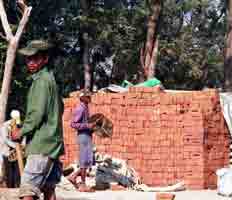
There are hundreds of these old temples scattered about the parched landscape, each with its reddish brown phallic tower thrusting up into the sky. Each king sought to out due his predecessors and at the same time purchase himself merit in the next life by building the biggest and best. There are so many, they form a skyline. When I look at these monuments I do not see devotion or piety, rather these seem to me to be monuments to the inflated egos of the monarchs who had them built and to the toil and sweat of those forced to labor in their construction. Perhaps I am wrong. Could be that these ancient craftsmen were grateful for the employment or they were pious men who believed they were building up their own karmic merit to ease their way into the next life; however, I am told much of the construction was done with forced labor. I can see the workers bent over stripped to the waist, the dripping sweat cutting stripes along backs and chests stained red by the red clay dust, placing brick after brick; day upon weary day and to what purpose? We visit four more pagodas, each little different from the last. Just another pile of bricks! The architecture of each pagoda seems tiresomely similar, but then I find much of Asian art, particularly Buddhist art, repetitious and devoid of individuality. I am thinking of a verse from the Upanishads:

“He who sees diversity goes from death to death.”


Enjoying this taste of gem adventures? Interested in reading more? I have traveled to most of the major gem producing areas in Asia, Africa, Australia and Latin America. You are cordially invited to travel with me to some of the most remote areas on earth in search of the world's finest gemstones. Read a free chapter of Secrets Of The Gem Trade, The Connoisseur's Guide To Precious Gemstones: www.secretsofthegemtrade.com


Wednesday, July 26, 2006

Burma Journal: On The Road to Mandalay


Burma Journal; The Road To Mandalay

© 2006
by Richard W. Wise

Day one:

I take the night plane from Bangkok and arrive in Yangon on Tuesday, March 1st. My old friend Lwin (pronounced Lu-win) my guide during my last trip met me at the airport. Lwin is a dark haired, middle aged fellow dressed in the traditional Burmese Longji, a tight wrap around skirt. An ethnic Shan, Lwin grew up in Mogok, a member of the tribe that has controlled the gem mining districts for centuries.

I Checked into an old hotel in the old part of downtown Rangoon. (I am having trouble using the new terminology, Burma will always be Burma and I prefer Rangoon to the newly minted “Yangon.”) The hotel is an old one with its dusty corridors, polished teak floors, squeaking ceiling fan and wide shutters it thrusts me back into my daydreams of old Burma.

My plan for a second visit to the ruby mining town of Mogok in the famous Valley of the Serpents has been derailed. The valley has, once again, been closed to westerners. The army has screwed the lid down tight. Lwin’s old friend the general, from whom we got a pass last time, has been put in jail. Oh well, I only traveled twenty-five thousand miles to get here. Lwin has an alternate plan. He suggests that we travel to Mandalay by car. Mandalay is only about six hours from Mogok. Lwin will contact the miners who will meet us in Mandalay. Meanwhile I’ll get to tour the country.

We will take it easy and do the trip in three stages... The first day we will drive two hundred miles upcountry and stop in a small town at a hotel that Lwin knows well. The second stage, another five or six hours by car, will bring us to the ancient temple city of Pagan (Bagan). We will visit and photograph a few of the major pagodas, stay overnight, and travel the short leg to Mandalay the next morning. The more I chew over this suggestion the better I like it. It’s a chance to see the countryside. After a hectic week in Bangkok I can use a break.

The next morning promptly at nine, (Lwin) and his friend John, (a thin dark skinned missionary educated Burmese of about fifty with an excellent command of English) show up and we plan our itinerary. The only thing I don’t like is the return, four hundred miles from Mandalay to Rangoon. in one shot. Lwin proposes an alternative. One way by air!, that sounds better; ok, deal!

We spend the morning visiting Rangoon dealers who have ruby and sapphire to sell. Prices, as my Bangkok contacts predicted, are very high, as high or higher than in Bangkok. Only see one stone I like, a 1.74 carat cushion shaped Burma ruby from the new mine at Namya. The color is not quite right so I pass without making an offer. I bought three exceptional heated rubies from the Mong Hsu mine in Bangkok. One oval started off at 1.88 carats. The stone showed exceptional “pigeon blood” color but required a slight shaving of the pavilion, a small sacrifice of weight to sharpen the crystal and bring out the saturation it finished at 1.74 carats. Mong Hsu stones are often a purer red hue than old mine stones; the usual secondary hue is purple. Mogok rubies tend toward the pink. Another, a 1.36 carat round (pictured) was a real find. I found another, a 3.60 carat oval paradigm, one of the finest rubies I have ever seen. Perfection is expensive but I had to buy it.


Natural color or burned (heat treated), rubies of fine color are extremely scarce, almost as rare as untreated. I must have closely examined over a hundred burned stones. In the ruby trading capital of the world, I saw almost nothing of fine color. One more stop and we see a few more rubies and a large sapphire. The sapphire color is good the lovely purplish blue “peacock” hue that Burma is famous for but unfortunately the stone is overcolor, too dark in tone.

I return to the hotel for checkout. First stop a small local restaurant that Lwin favors. The restaurant located on a side street It has an front wall open to the street. It’s a little lacking in ambience, with plain well-scared wooden tables, serviceable chairs and no tourists, a restaurant in a garage. We amble up to the front counter that is set up sort of delicatessen style. With Lwin’s guidance I pick out my dishes. The place is bustling, people dressed in the traditional Longji with a western shirt or top, eating talking and generally having a good time.

Burmese cooking features a broad palette of herbs and spices. We try mint leaves, chili, lemon, and a saffron flavored curry all served over rice. Burmese food pleasantly hot but Lwin cautions, beware of the cute little green chilies, they can change your life.

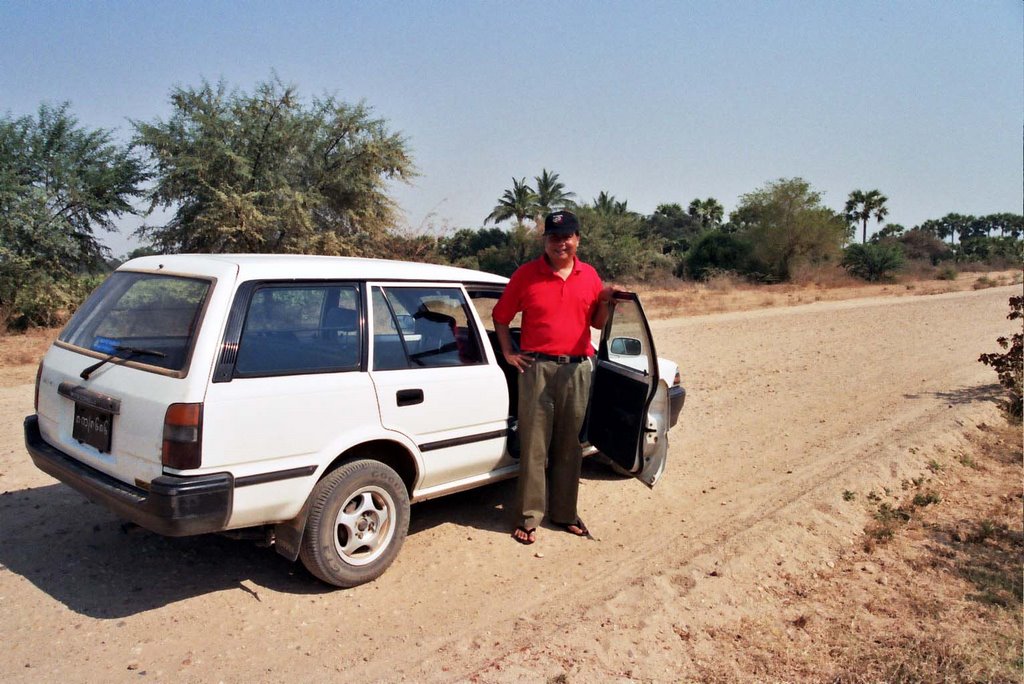
Fuel, gasoline and diesel is rationed in Burma. You are allowed two gallons per day. Lwin has a coupon book. Although his 1990 Toyota Corolla is diesel, this trip will require a good deal more than two gallons of fuel Per day. The two gallons are very cheap, 160 kyat. (900 kyat = $1.00 on the black market, the official rate is 500). For additional fuel you must pay the black-market price, about two fifty US per gallon at the unofficial exchange rate. Luckily you do not have to go down a dark alley or know the secret handshake; you just pay the additional money and receive your fuel at the same government controlled gas station where you purchased your legal ration.

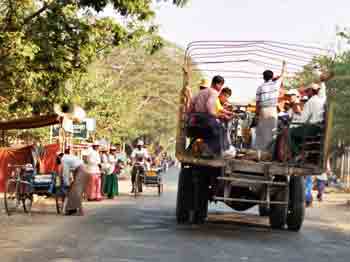
Well, its 2;00 PM., fed and fueled, off we go on the first leg of our trip along the road to Mandalay. Once we clear Rangoon‘s noisy environs, we find ourselves on a blacktopped one and a half lane country road with traffic moving in both directions. The day is hot and the road dusty. The ride through the countryside is not disappointing. This road, clearly a main artery, provides a running panorama of life in rural Burma. Did I say rural Burma? All of Burma outside the few cities is rural. Burma is a nation of farmers.

Driving the road requires a bit of etiquette. Compact cars going in opposite directions can pass each other, barely. But if you meet a lorry there is a delicate two-step that usually finds the smaller vehicle giving the most ground. Luckily outside the city, most of the traffic is made up of bicycles, trishaws and bullock carts.

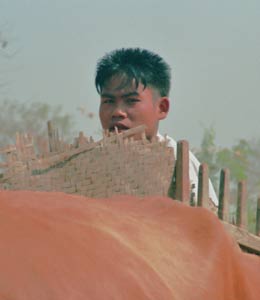
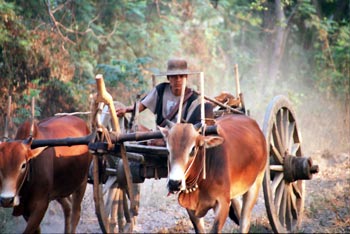
The trishaw is a unique and interesting vehicle. It is basically a bicycle with a one-wheeled sidecar. It is the Burmese peasant’s answer to the family automobile. With a little planning it’ can carry five. Two in the sidecar, (wife facing front, mother-in-law facing rear); one child on the rear fender and another on the front handlebars. If you are a farmer, the bullock cart may be your vehicle of choice. Two yoked bullocks power this handmade wooden beauty. A bit slow off the line, it sports a five-foot wheelbase and can easily carry a large family and the family groceries. It’s a multi-purpose vehicle, sort of a third world SUV. When not in use carrying passengers it is perfect for off-road use (harvesting crops). It is easily navigable through all but the deepest rice paddies.

Lwin is the type of driver whose driving style would reduce a New York cabbie to fear and trembling. His technique is simple: If its smaller just keep punching the horn until it moves to the side of the road. If the vehicle is bigger than you are; keep on keeping on until the very last minute. The other guy will probably give a little and if that’s not enough its up and over the shoulder. Watch that bullock cart! He has a manual shift, four on the floor, but mostly uses two just two…fast and stop. At the end of the journey I can recall only one instance when we were passed (a large bus on a dirt road). The rest of the time it was us passing them. The man is the Burmese version of a grand prix racer. I am sure we passed half the motorized vehicles in Burma.

Along many sections of the road huge ancient Acacia trees, dating from the days of the British Raj, form a canopy shading the road.. Rice appears to be the dominant crop and we pass field after field with rows upon row of tender green shoots.

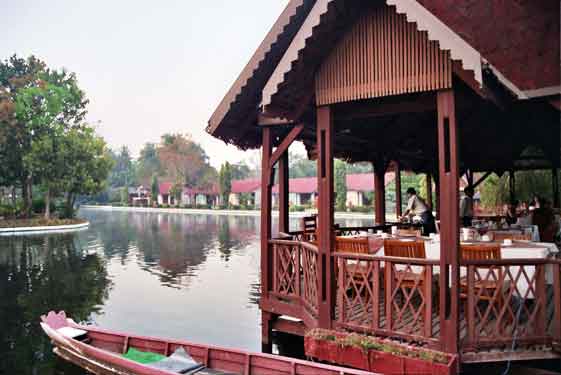
Six hours later we pull up at a bungalow hotel in the small town of Brome about two hundred miles south of Bagan. The hote

l is situated on a small lake and we eat our dinner al fresco on a covered deck overlooking the water. The food is good; I have a chicken stir fry dish laced with cashews. The night is hot and sultry, the food delicately flavored. Burmese music blasts from a loudspeaker somewhere in the distance.
Like the blog? You will love the book!


"This book takes a much-needed sledgehammer to the industry's conventional wisdom about what makes a gemstone precious, and in the process builds a solid foundation for anyone who wants to understand the true beauty and value of gemstones."

Morgan Beard
Editor-in-Chief Colored Stone Magazine

Read a free chapter www.secretsofthegemtrade.com