Showing posts with label price. Show all posts

Thursday, May 17, 2007

Kashmir Sapphire Sets Record; A Victory for Style Over Substance?


A Victory of style over Substance?

April 25th at Christies, in a packed auction gallery, lot 261 a cushion cut 22.66 carat Kashmir sapphire set in a pendant surrounded by diamonds sold for a world record price of $3,064,000 to an anonymous bidder. At $135,000 per carat, this sale topped the former world record held by the 66.02 carat “Rockefeller Sapphire” a Burmese gem that sold for $48,871 at auction in 1991. This sale marks the ascension of sapphires found on a rocky hillside in the Indian State of Kashmir into the pantheon of super-star gemstones.

Speaking in the wake of the sale, Christie’s Head of Jewelry, Rahul Kadakia, made the following rather curious statement:

“This auction marks a turning point in the jewelry world where original design, rarity and provenance prove to be just as important as the quality of a gem.”

What precisely did Mr. Kadakia mean? Is he celebrating the final triumph of style over substance? Does he mean that the sapphire in question though rare is not so fine? The record breaking sapphire pendant (above) is certainly not a striking example of original design.

According to Christopher Smith, Vice President & Chief Gemologist at The American Gemological Laboratory, the sapphire in question is a “nice stone”. Smith, who has seen the stone but under less than ideal circumstances, makes the point that sapphires of the finest color tend to be a bit dark particularly in subdued lighting. This stone is a bit lighter and brighter at about 70% tone on the AGL scale where 80% would be ideal. The stone is well proportioned, brilliant and on a scale of 1-10 would rate between 8-8.5.

As to the gem’s provenance, interesting though not remarkable, it was never owned by royalty nor lost on the field of battle nor has it had any remarkable stories or curses associated with it. It was purchased by James J. Hill, a Minnesota industrialist of the Gilded Age, and given to his wife, Mary, on Dec. 24, 1886. Originally part of an elaborate necklace—since broken up-- the sapphire remained in the Hill family until the death of Hill’s granddaughter Gertrude Boeckmann Follett, in 2006.

So what business does a nice sapphire like this have claiming a record price? Well though it may not be able to stand toe to toe with the former record holder, the 66 carat Rockefeller Sapphire (image:right), which is in Smith’s words “extraordinary” and one of the “world’s preeminent sapphires”, it is rare. Kashmir sapphires in excess of 20 carats are quite rare and if you own one it’s a seller’s market.

The fact is the finest of the Kashmir sapphire has been recognized as the top of the mark in sapphire almost since the stone’s discovery in the late 19th Century. Celebrated for it’s cornflower blue color and its trademark sleepy quality, a gem with proven Kashmir provenance commands four times the price of a comparable Ceylon stone and twice the price of a comparable Burmese sapphire. Due to its beauty and rarity it was the next logical candidate for gemstone super-stardom.

Is this a “turning point”, a victory of style over substance, of provenance over quality in the gem markets? This much is obvious, just the price of natural Burmese ruby skyrocketed in the wake of the record breaking sale of the 8.01 carat gem at Christies just two years ago, Kashmir prices, already edging toward $100,000 per carat wholesale, will strengthen. Anything with a Kashmir certificate from gem quality to aquarium gravel will see a big boost in asking prices and the publicity will further induce star-struck consumers to choose geography first and quality second. But, this is not a new trend rather just a continuation of a trend that has been in evidence for quite some time.

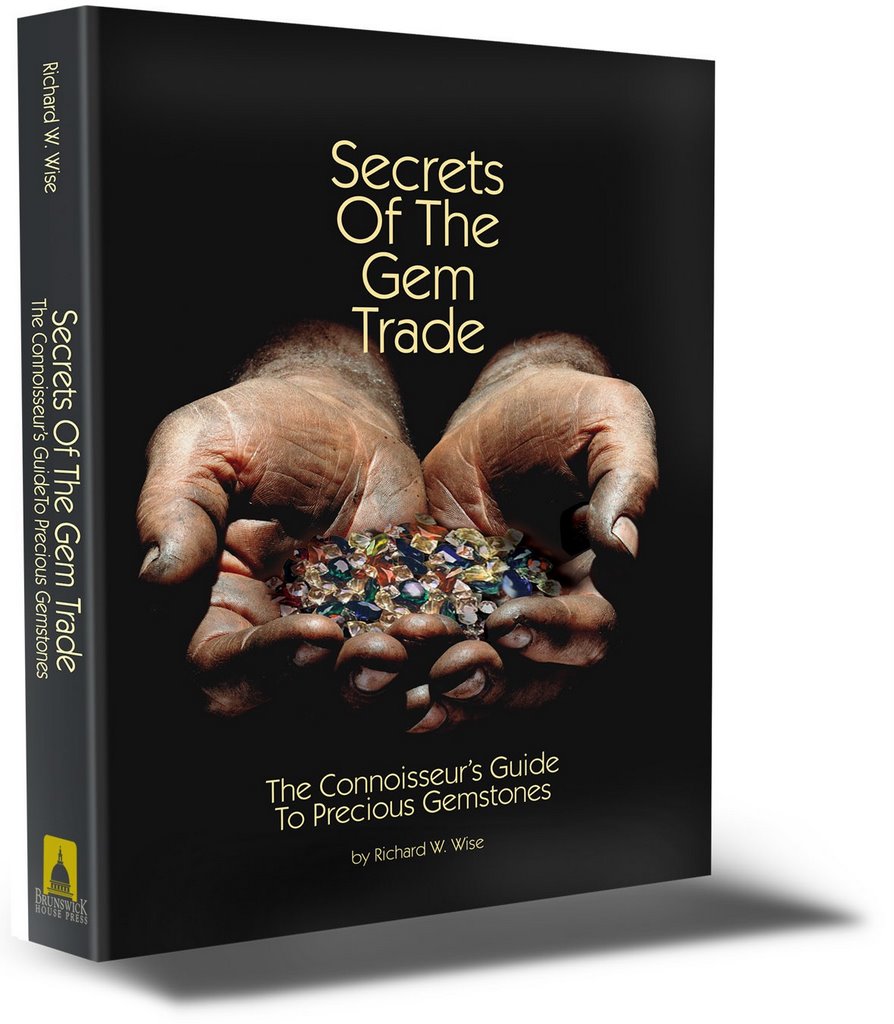
Follow me on gem buying adventures in the exotic entrepots of Burma and East Africa. Visit the gem fields of Australia and Brazil. 120 carefully selected photographs showing examples of the highest quality gems to educate the eye, including the Rockefeller Sapphire and many more of the world's most famous gems. Consider my book: Secrets Of The Gem Trade, The Connoisseur's Guide To Precious Gemstones.


“Wise is a renowned author... He’s
done a marvelous job of this first book, monumental work, a tour de force...My recommendation: Buy this book”.

Charles Lewton-Brain, Orchid

Only $39.95. Read a couple of chapters online: www.secretsofthegemtrade.com.

Buy it on Amazon: www.amazon.com

Saturday, October 21, 2006

Mozambique Cuprian Tourmaline, Part III


Mozambique Cuprian Tourmaline, Part III


Purple Cuprian; A dilemma:

By Richard W. Wise, G.G.

©2006


“I know what you're thinking. Did he fire six shots or only five? Well, to tell you the truth, in all this excitement, I've kinda lost track myself. But being as this is a .44 Magnum, the most powerful handgun in the world, and would blow your head clean off, you've got to ask yourself one question: Do I feel lucky? Well, do ya punk?”


Clint Eastwood


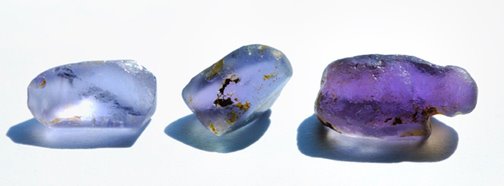
As tourmaline aficianados know, there are few truly rare colors of tourmaline. A pure yellow without a stong green secondary hue is quite rare and I have never seen a true violet but until recently, purple was the one spectral color that absolutely did not exist in tourmaline. Yes we had purplish reds but until last year when the Alta Lighona tourmalines from Mozambique entered the market, never a stone with a purple primary hue. (pictured above: 15.5 carat purple Mozambique cuprian tourmaline courtesy Pala International)

In early 1989 when the first curpian tourmalines from Paraiba appeared in the market in Brazil some were sold unheated. Most of these stones were a dark toned greenish “sapphire” blue, a “Thai sapphire blue” to be precise. In those days, blue was the most expensive, elusive and sought after color in tourmaline. Rumors whispered of a pure blue gem that was reputed to rival the finest in Burmese sapphire. This was the holy grail of tourmaline. I recall holding on to one parcel of natural dark blue Pariaba for several years before I burned them just in case the demand for the medium electric blue proved to be a passing fancy. Well, as we know it did not and when I finally did heat it, the result was a half dozen pure medium toned visually pure Carrribean blue gems that I sold at a substantial profit.

Since that time I have seen many examples of blue tourmaline including the famous Manoel Mutuca (described by Proctor as “sapphire blue” see Gems & Gemology, Spring 1985, p.11)) and Santa Rosa material but none (at least so far) with a true pure blue hue. Blue tourmaline always has a distinct greenish secondary hue which becomes quite evident when it is compared stone to stone with fine sapphire. Blue tourmaline can be exceptionally beautiful but it looks like tourmaline not sapphire.


To burn or not to burn or "Do I feel lucky? Well, do ya punk?”


With the entry of Mozambique curprian tourmaline we have a dilemma similar to the situation with the early Brazilian curprian tourmaline namely that some of the unburned material has a rich pure purple hue that reminds one of Siberian amethyst or fine purple sapphire. The difference is that unlike the rather dull greenish blue unheated Paraiba, this stuff is beautiful,

The Mozambique purples have a hue that is rich and pure. So, to burn or not to burn, that is the question, according to both Gene Flanigan from Precision Gems and Josh Hall at Pala International, these deep purples are also the best candidates for the oven, they heat to a neon pure medium “Paraiba” blue.

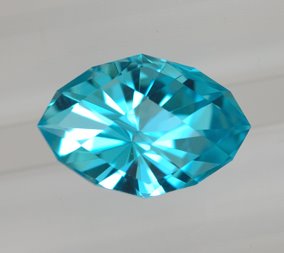
Some dealers have chosen the obvious solution. If you want a pure purple but burnable stone they will charge the same price as for the neon blue.(pictured above: unheated cuprian rough from Mozambique). Pictured below is an exceptional 1.89 carat custom cut Carribean blue cuprian stone cut from the center piece of rough. After and before; the first image shows the cut stone before heating. The second image shows the stone after the heating process was completed. The stone, currently available for sale at www.rwwise.com was cut by Gene Flanigan a very talented lapidary artist from upstate New York. (Images courtesy Gene Flanigan: www.precisiongem.com)

Will purple tourmaline go the way of fine star sapphires that hardly exist anymore because they can be burned and faceted? I don't think so, some of the fine purples simply possess problematic inclusions that make them risky candidates for burning. I found an 8.19 carat oval, a lovely example of Mozambique purple on my last trip to Asia. This stone faces up clean but under magnification shows long growth tube inclusions and cannot be burned. It is out having its picture taken and will be posted in a later blog. Logically purple cuprian tourmaline will have a two track price structure. Stones with a high degree of clarity under the loupe will sell for prices that may be double that for stones with certain types of inclusions whether visible or not.

Bits and Pieces:

I get lots of emails. Don't think I'm not grateful. Every once in a while a real interesting one comes through the mailbox. take this on:

Position Available:

Dear Mr Wise,
We are Stargate, diamond trading division of Ebenhaezer Bank Consulting Group of Belgium, operating in thirty countries worldwide. We have read your blog regarding the appraisal of stones by qualified experts. We have constant need of qualified gemologists, expert in assessing ROUGH DIAMONDS, and have great difficulty identifying where they can be located.
We offer good working conditions, contracts, and a fair remuneration.
A special need has arisen in Bangui, Central African Republic, where we are currently (this week) accepting a large consignment. We require the services of a qualified gemologist, expert in rough diamonds, to assist our team there.
Would you be kind enough to assist us at your earliest convenience?

Yours sincerely,
Lucilla Arioti
Global Client Relationship Manager, EMEA
Stargate,
a division of Ebenhaezer Bank Consulting Group
Telephone: London +44 207 870 5389

I am not familiar with Stargate but believe the lady is serious. She even called and left a message on my machine. So if you are a gemologist in search of adventure give Lucilla a jingle. This time next month you could looking at sparklies and sipping pina colodas in beautiful downtown Bengui. As for myself I'd love to go along but I can't give up my day job but when you get there be sure to drop me a line and oh do
be sure to take along a flack jacket.

New Site with excellent online library of inclusions:

Got an email from a French gemologist:
Marie-France Boursier-Brard. Ms Boursier-Brard has developed an excellent site with online images of inclusions. The site is quite comprehensive and well organized. Just click on: www.gemmes-inclusions.com


Check out my book Secrets of The Gem Trade; The Connoisseurs guide To Precious Gemstones: www.secretsofthegemtrade.com.


Now at 30% off just $27.95

"This book takes a much-needed sledgehammer to the industry's conventional wisdom about what makes a gemstone precious, and in the process builds a solid foundation for anyone who wants to understand the true beauty and value of gemstones."

Morgan Beard
Editor-in-Chief Colored Stone Magazine